How a Two-Person Analytics Startup Used Its Blog to Win Customers From Google


*** Every week, we pick apart how the world's best media brands got to where they are. This post is the long read. Growth Curve, our weekly newsletter, is the sharp version: same insight, shorter format, straight to your inbox. Subscribe free here. ***
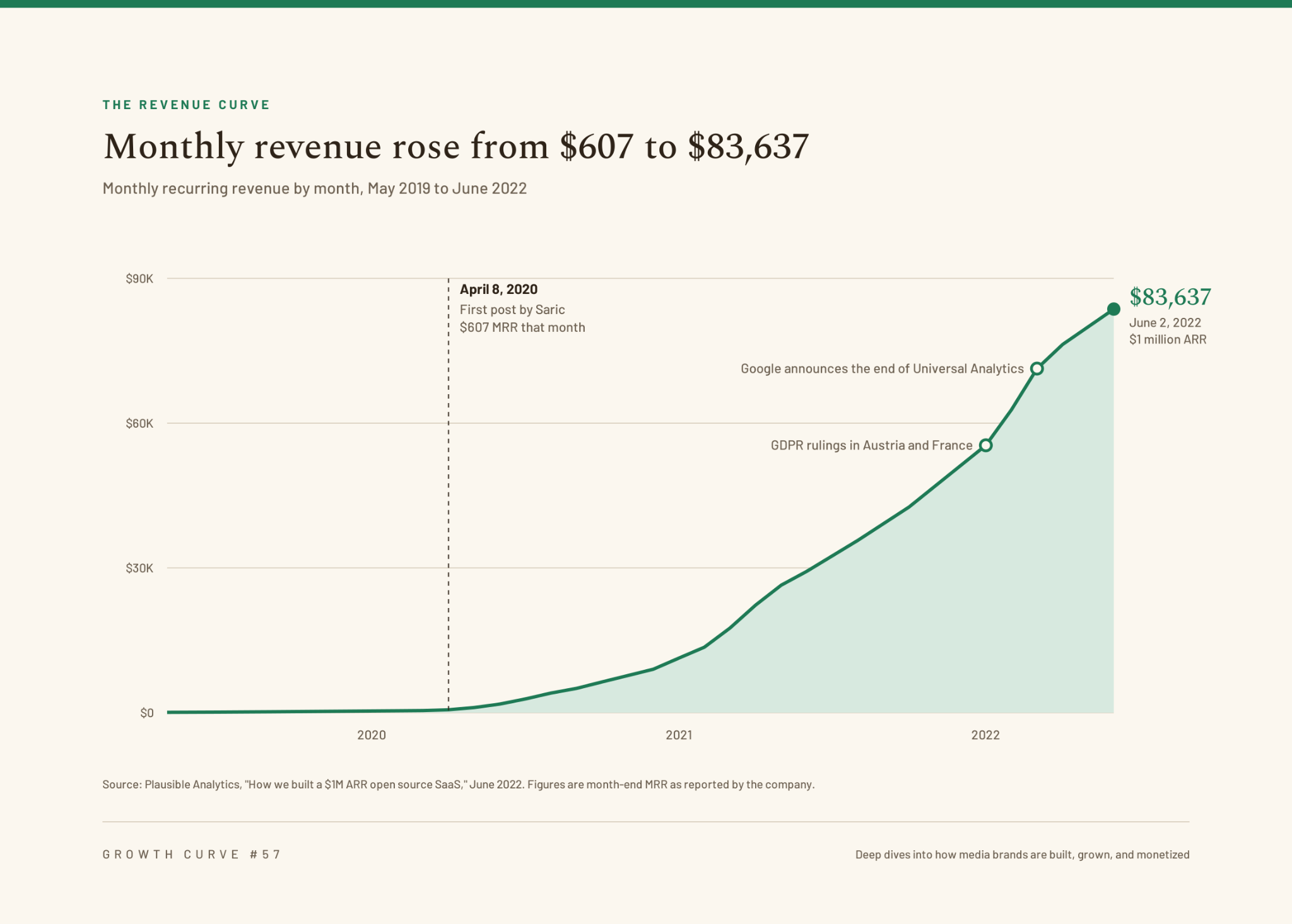
In December 2018, developer Uku Täht wrote the first line of code for Plausible Analytics, a privacy-friendly alternative to Google Analytics. Paid plans launched in May 2019. Ten months later, the business was still making about $400 a month. In March 2020, marketer Marko Saric joined as co-founder and rebuilt the company's marketing around its blog. His first post, published on April 8, 2020, told website owners to stop using Google Analytics. More than 25,000 people visited the site that day.
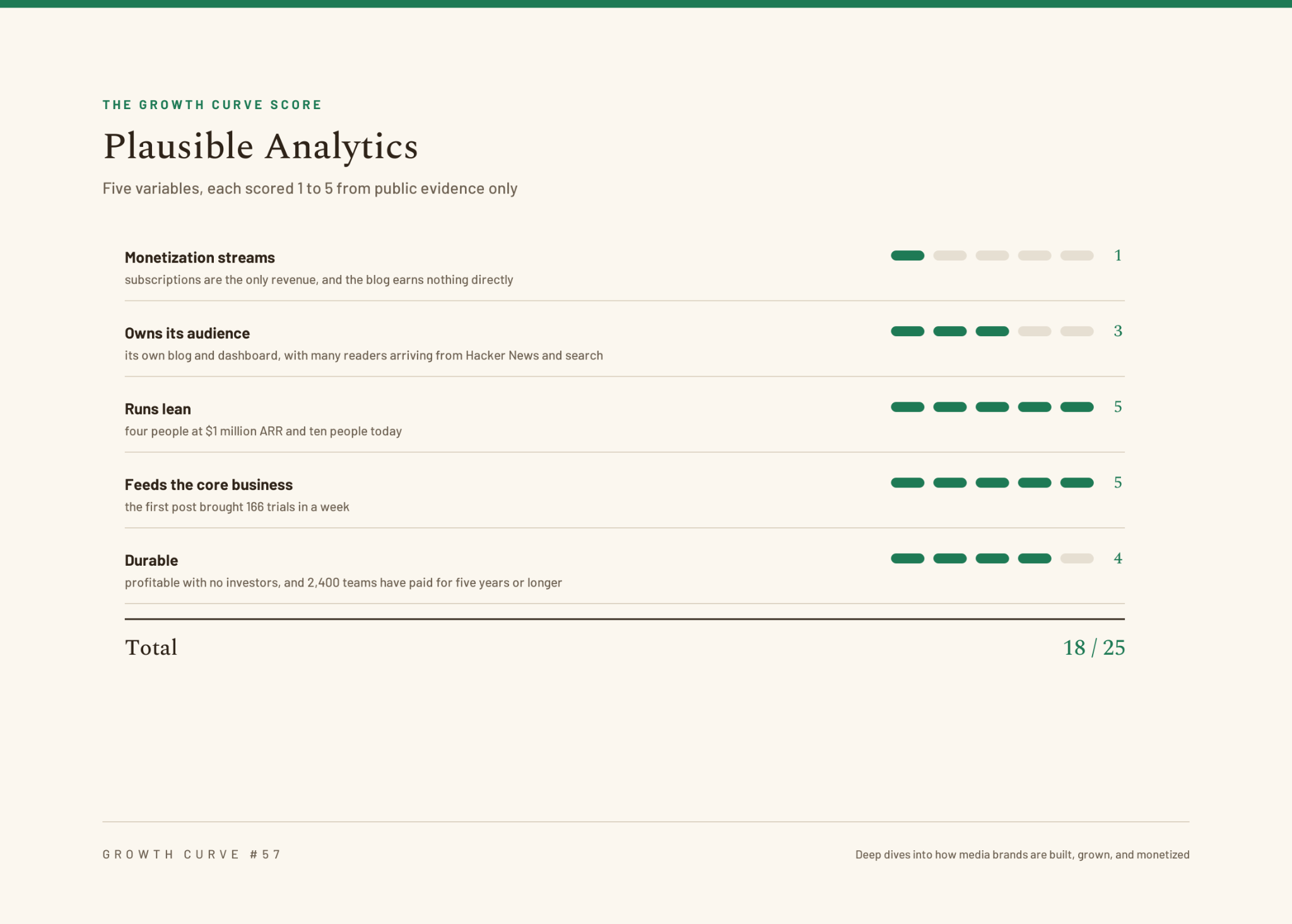
Through 2020, Plausible published about one opinionated post a week. It shared its revenue and website traffic publicly and never paid for advertising. On June 2, 2022, it reached $1 million in annual recurring revenue (ARR) with a team of four and more than 7,000 paying subscribers. Today, the company reports more than 22,000 paying subscribers and a team of 10, still with no outside investors.
A Side Project Stalls at $400 a Month
Täht got the idea while working as a developer. The marketing head at his company asked him to add Google Analytics to a landing page, and his first thought was to ask whether they could use something else. He wrote the first code in December 2018 and launched a public beta on Indie Hackers in January 2019, posting every update and milestone there and on his own Twitter account.
Paid subscriptions launched in May 2019, when Plausible had 60 active beta users. The first paying subscriber signed up on May 14, and the month closed at $64 in monthly recurring revenue (MRR). Because Google Analytics was free, Täht priced the entry plan low to give small-site owners a reason to switch.
In July 2019, a post titled "You probably don't need a single-page application" reached the front page of Hacker News and drew more than 2,500 visitors in one day. MRR ended the month at $118. In September, Plausible released all of its code on GitHub under the MIT license. By February 2020, MRR was $403, and Täht announced he had found a partner. It had taken 324 days to reach the first $400.
A Marketing Co-Founder Picks a Fight With Google
Täht found Saric by reading a post Saric had written on how to remove Google services from a website, then cold-emailed him. Saric started on March 16, 2020. The day before he joined, the site had 49 visitors and none from Google search. His first goal was ten visitors a day from Google.
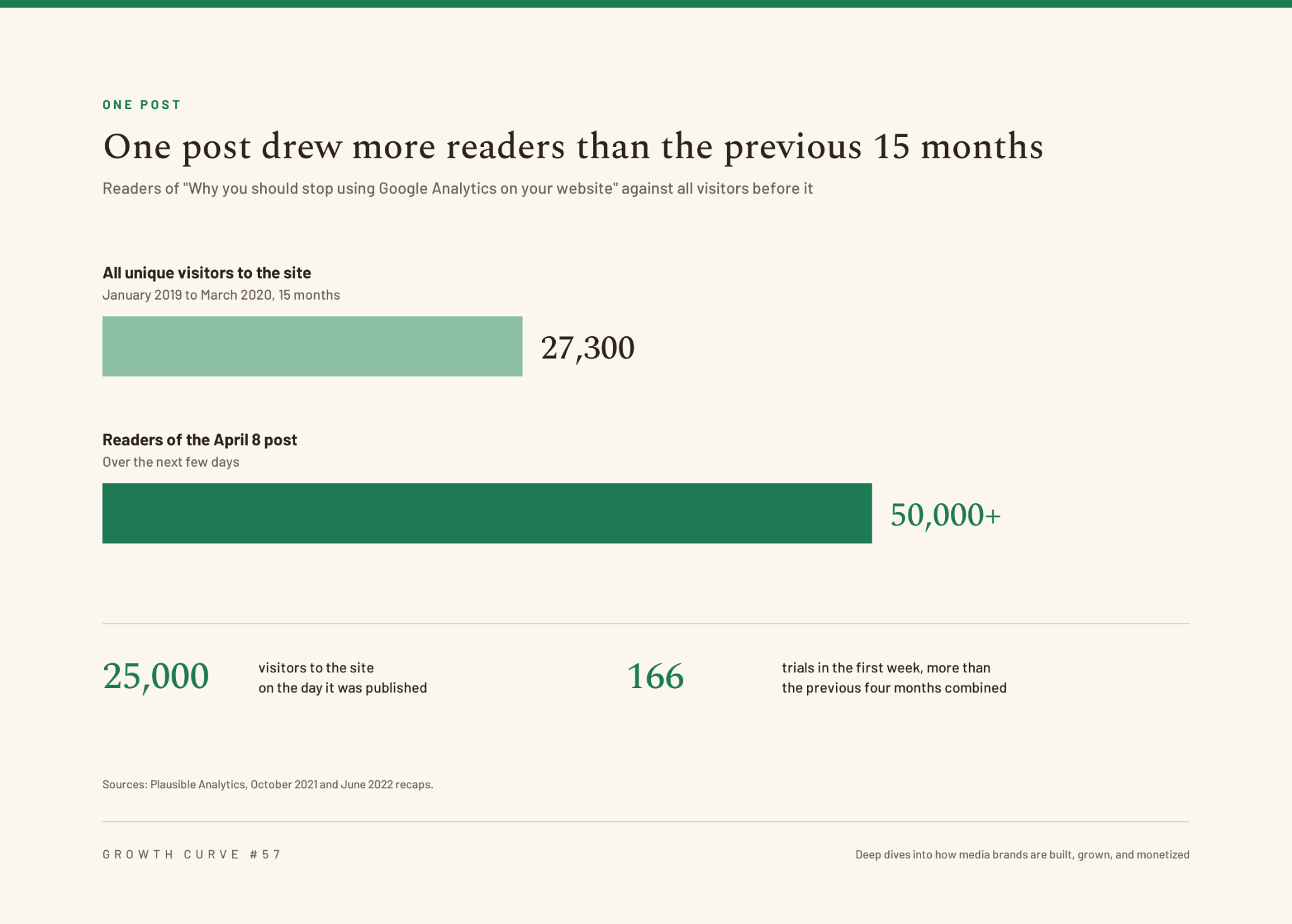
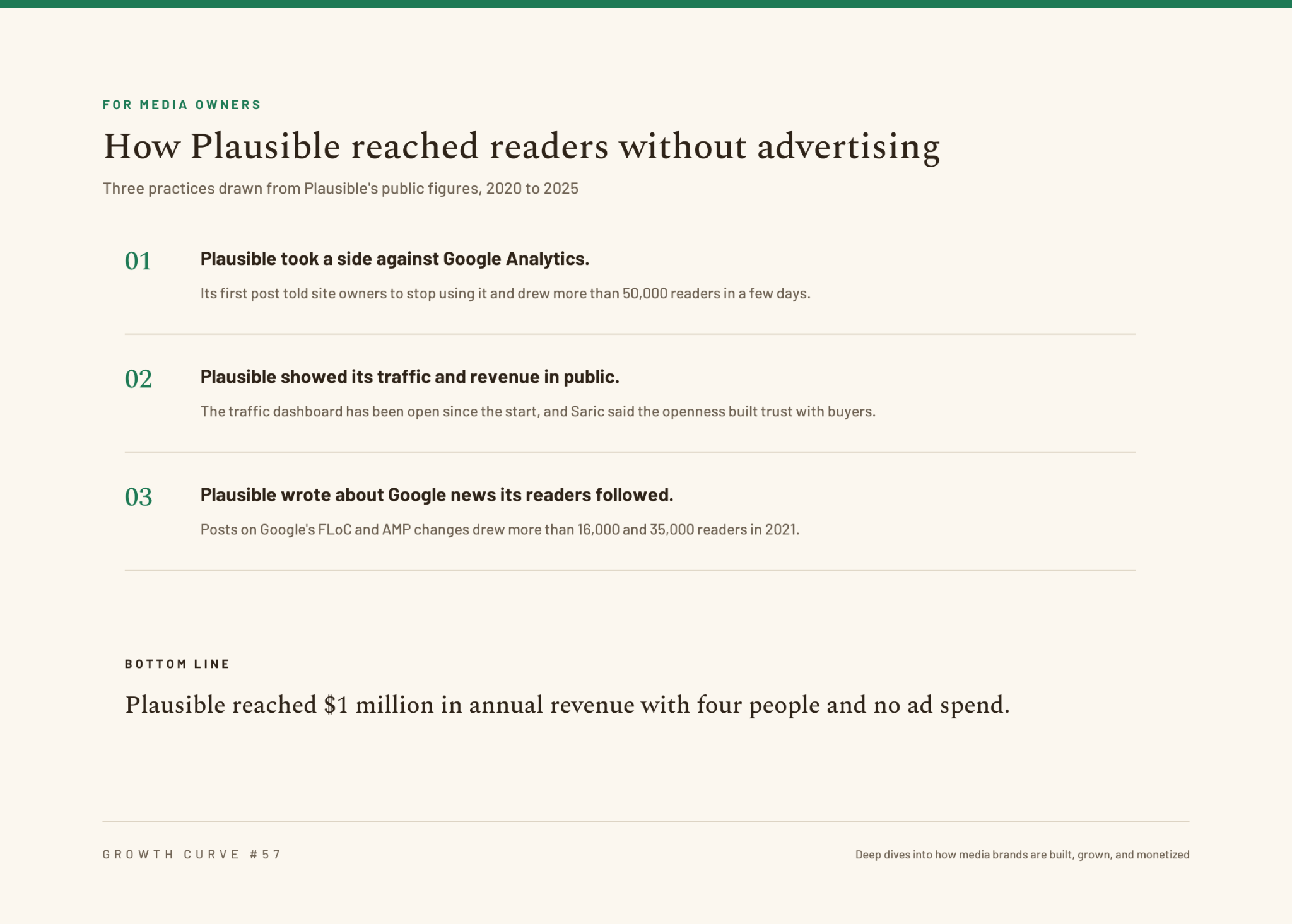
He spent the first weeks on positioning. Plausible became a "simple, lightweight, open source and privacy-first" alternative to Google Analytics. Then "Why you should stop using Google Analytics on your website" went up on April 8. It reached the top of Hacker News' front page. More than 50,000 people read it over the next few days. Before the post, Plausible had drawn 27,300 unique visitors in 15 months. In the week after, 166 people started trials, more than the previous four months combined.
Plausible offered a 30-day free trial and MRR doubled in May 2020 to $1,055.
One Post a Week
Over the next four months, Plausible published 15 posts, about one a week. Most covered what site owners were searching for about Google Analytics, privacy, and cookie banners. Others took a position on the news. A July 2020 post on paying rent with an open source project brought more than 35,000 visitors in a single day.
Plausible's Product Hunt launch in August 2020 brought more than 1,000 visitors and 15 trial signups that day, but fewer than 20 visitors a day soon after. Saric described community launches as a spike of hope followed by a flat line.
The founders lived on savings through 2020 and paid themselves their first salaries on September 10, in a month that closed at $5,035 MRR. By January 2021, MRR passed $10,000. By then, the two were down more than $50,000 in personal savings, and the business could finally cover its costs.
The content kept working through 2021. A post on how to resist Google's FLoC tracking proposal drew more than 16,000 readers in April. A post on Google ending preferential search treatment for AMP pages drew more than 35,000 readers in a couple of days. In August, Plausible published a study of its own traffic data titled "58% of Hacker News, Reddit and tech-savvy audiences block Google Analytics." More than 30,000 people read it within 24 hours, and trial signups more than doubled over the next five days.
Publishing the Numbers in Public
Plausible's own website statistics have been public on a live dashboard since the start. In July 2020, Saric published the company's top 10 referral sources for the previous four months, led by Hacker News with 43,600 visitors.
In October 2020, Plausible moved from the MIT license to the AGPL after its growing reach made it aware of companies that could take advantage of a permissive license.
Google Bring the Next Wave
By October 2021, Plausible had reached $500,000 in ARR with almost 5,000 paying subscribers, two full-time founders and one part-time employee who handled technical support. In January 2022, Austria's data protection authority ruled that a website's use of Google Analytics violated the GDPR. France's authority reached the same conclusion in February. Plausible, which runs only on EU-owned cloud infrastructure, wrote about each ruling and saw interest rise after both.
In March 2022, Google announced that Universal Analytics would stop collecting data and that historical data could not be moved to GA4. Plausible added net MRR of $8,247 that month, its best month to date, and in April released a tool that imported old Google Analytics data into Plausible. On June 2, 2022, MRR reached $83,637, or $1 million ARR. Plausible had more than 7,000 paying subscribers and measured traffic on more than 50,000 websites.
A Profitable Business With No Plans to Sell
Plausible stopped publishing revenue after the $1 million milestone. Saric told the Subscription Heroes podcast in August 2025 that sharing the numbers had started to feel like bragging. He said the company had grown a lot since then, that May 2025 was its best month yet, and that average revenue per customer was about $30 a month. The entry plan costs $9 a month, up from about $5 in 2021.
The company's about page now reports more than 22,000 paying subscribers, a team of 10, and more than 2,400 teams that have paid for five years or longer. It names Stripe, Mozilla, Basecamp, Hugging Face and the Python Software Foundation among its users.
The marketing rules have not changed. Plausible says it has never spent money on advertising, affiliates, or paid endorsements. Its 2022 milestone post also ruled out retargeting, pop-ups, and chatbots. In 2024, with version 2.1.0, it split the software into a self-hosted Community Edition, still under the AGPL, and a managed cloud service that keeps some newer features for paying customers.
Google and ChatGPT Now Bring Equal Trial Signups
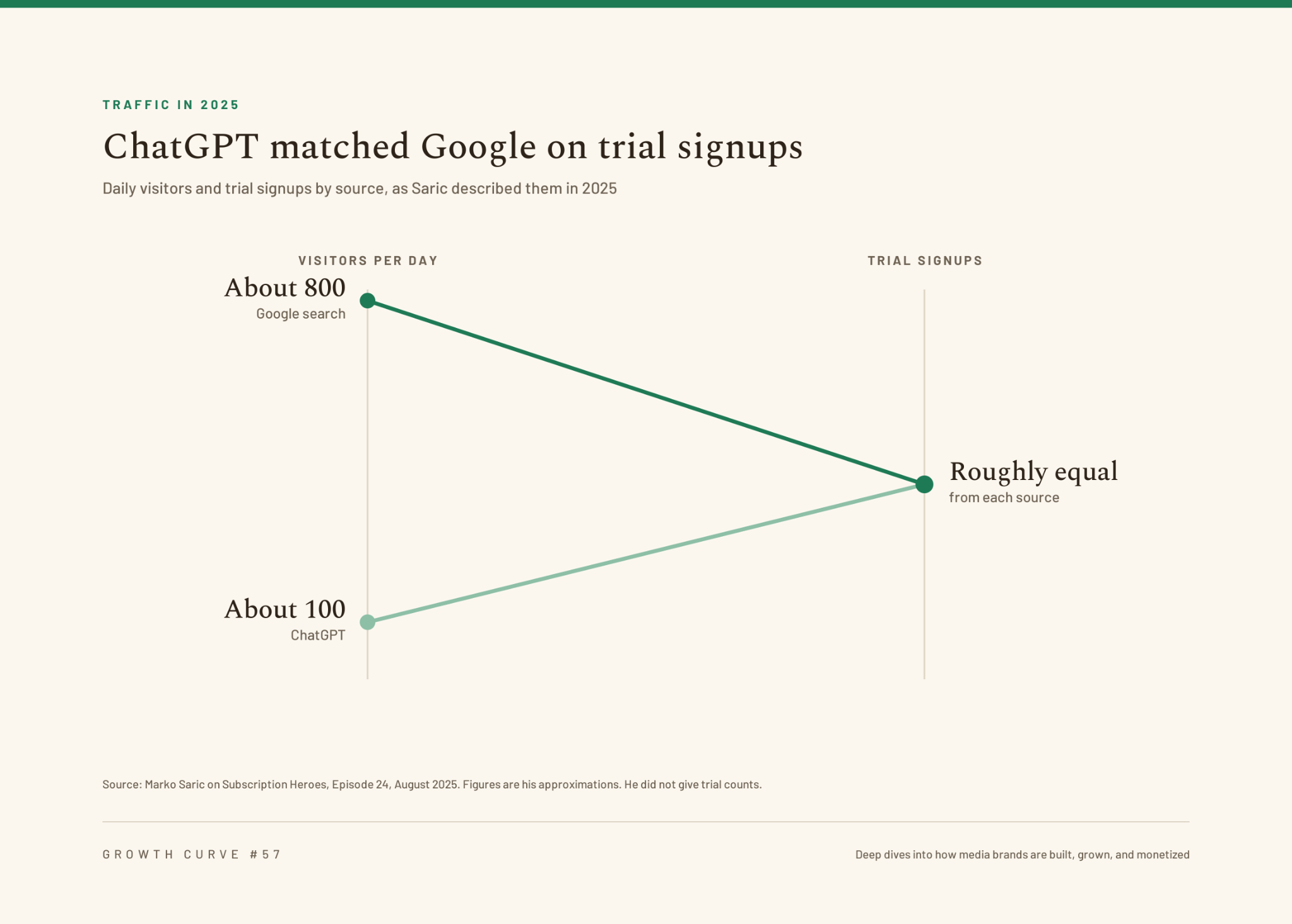
In the same interview, Saric said Plausible now publishes far less often than it did in its first years. Google search sent about 800 visitors a day, and ChatGPT sent about 100. The two produced roughly the same number of trial signups, and Saric said ChatGPT would pass Google within months if the trend held.
Plausible spent nothing on advertising between its first post in April 2020 and its $1 million milestone in June 2022. Its marketing came down to taking a clear position against Google Analytics and publishing its revenue and website traffic. Saric has said that openness built trust in a market where buyers care what happens to their data. For small publishers, a clear editorial position and transparency about business performance can help build an audience and earn trust without a large marketing budget.
Growth Curve Score
*** Every week, we pick apart how the world's best media brands got to where they are. This post is the long read. Growth Curve, our weekly newsletter, is the sharp version: same insight, shorter format, straight to your inbox. Subscribe free here. ***
Your newsletter won't build itself.

How a Two-Person Analytics Startup Used Its Blog to Win Customers From Google

How an Austin Home Builder Grew a Media Company Beside Its Construction Firm

The 2000s Blog That Keeps Finding New Monetization Models