How a Weekly Email From Gwyneth Paltrow's Kitchen Built a $250 Million Wellness Brand

*** Every week, we pick apart how the world's best media brands got to where they are. This post is the long read. Growth Curve, our weekly newsletter, is the sharp version: same insight, shorter format, straight to your inbox. Subscribe free here. ***
------------
In September 2008, Gwyneth Paltrow started sending a weekly email from her kitchen to a short list of friends, family, and friends of friends. She built it on off-the-shelf software and wrote her lists of recommendations, recipes, and product reviews herself. The early editions offered New Age advice such as policing your thoughts and eliminating white foods, under the slogan "Nourish the Inner Aspect," with an editor's note from Paltrow in each issue. The name came from a suggestion that successful internet companies tend to have double Os in their name, and she wanted a word that meant nothing and could mean anything. Goop was incorporated in 2011 and later centralized its operations in Santa Monica, California. Seventeen years later, that weekly email had become a wellness and lifestyle company with a reported valuation of $250 million by 2020.
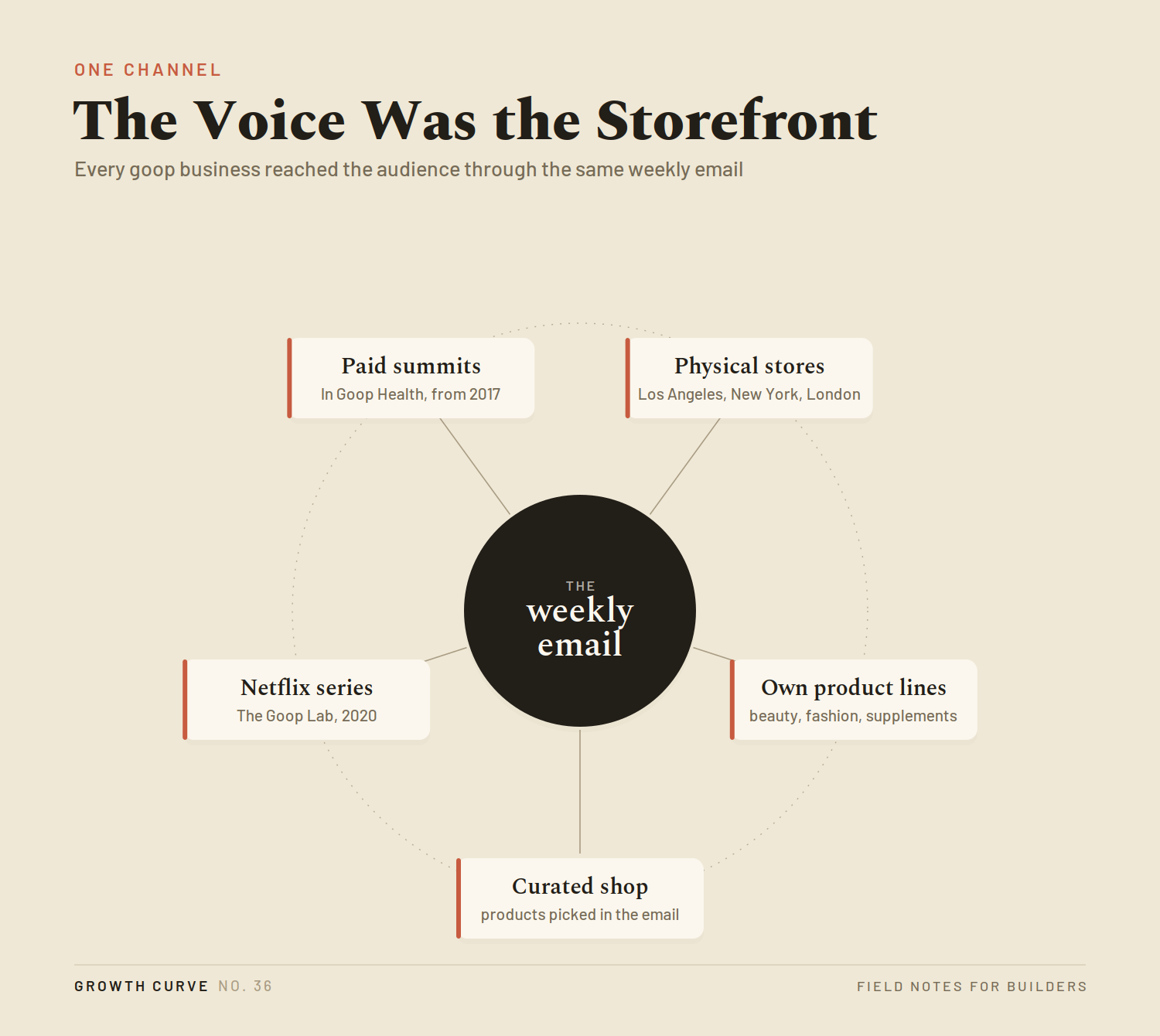
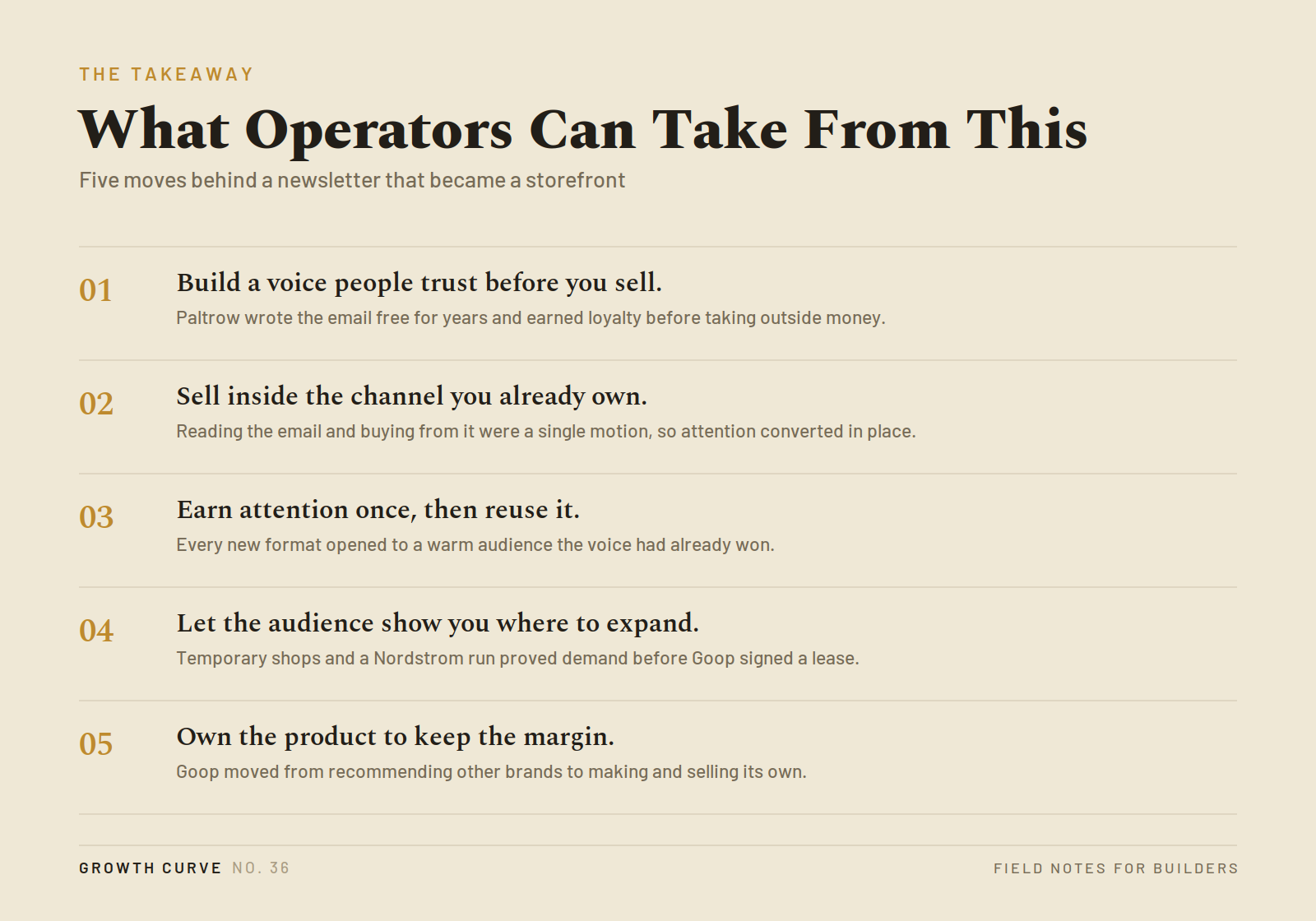
The newsletter carried Paltrow's voice to millions of women. Her curation turned into inventory, then into product lines, then into stores and paid events. Every business Goop added reached the audience first via the same email that started it all.
The Email Came First
For years, the product was the email. Paltrow wrote every newsletter introduction herself, helped select every product and partner, and shaped Goop's very personal tone. She relied on a curated Rolodex of doctors, chefs, and experts to provide exclusive recommendations, and she focused on building subscriber loyalty before pursuing outside capital. She became an early student of the attention economy, learning how to hold and direct a reader's focus.
Goop began by pointing readers toward other people's products, and the curated shop was a natural extension of the writing. A reader who already trusted the recommendation was one click away from buying it, so reading Goop and shopping Goop became a single motion. The company positioned itself as a bridge between a reader's lifestyle questions and a set of exclusive answers. Sales of Goop products grew sixfold year over year over a five-year stretch, and in 2017 the company was on track to nearly triple revenue. The editorial voice and the cart sat side by side.
Goop Started Stocking Its Own Shelves
Once the audience reliably bought what the email recommended, Goop began making the products itself. It launched its own clothing line, G. Label, a Goop fragrance, a beauty range, and nutritional supplements, which generated $100,000 in orders on launch day. Owning the product meant owning the margin, and the newsletter gave each launch a warm audience on day one. In September 2017, Goop also launched a print magazine published by Condé Nast that retailed for $15, with Paltrow on the cover of the first issue. The brand was now writing the content, selecting the products, manufacturing some of them, and selling them through one voice. Goop later split from the Condé Nast publishing group and brought it in-house.
In May 2014, Goop opened its first pop-up shop, a two-story boutique at the Brentwood Country Mart in Los Angeles. It ran temporary stores in places like the Hamptons and Dallas, as well as a nationwide collaboration with Nordstrom. The first permanent store, named the Goop Lab store, opened at the Brentwood Country Mart in 2017 as a 1,300-square-foot space designed by Roman and Williams to feel like a bungalow, with rooms for fashion, beauty, home, and an apothecary. Goop went on to run three permanent stores in Los Angeles, New York City, and London. The reader list told Goop where its buyers were clustered before it signed a lease, which made the physical bet a measured one.
Readers Bought Tickets
Goop then charged the audience to spend a day inside the brand. The first In Goop Health summit took place on June 10, 2017, in Culver City, California, drawing roughly 600 attendees and tickets priced from $500 to $1,500. The tiers were named after crystals, with a $500 lapis ticket, a $1,000 amethyst ticket that added a cocktail reception, and a $1,500 clear quartz ticket that included lunch with Paltrow. It sold out. The summit then moved to New York in early 2018 and went international. The 2019 London edition ran from a £1,000 day ticket to a £4,500 weekend ticket. When the pandemic arrived, Goop made the summit fully digital in 2020, dropping the pass price to $5-$50 and adding a private Slack group for attendees. A 2023 summit at Goop's Santa Monica headquarters capped attendance at 139, with a $1,200 day ticket and a weekender that ran $3,500 to $4,000. The readers who opened the email paid to sit in the room with the person who wrote it.
The Money Followed the Audience
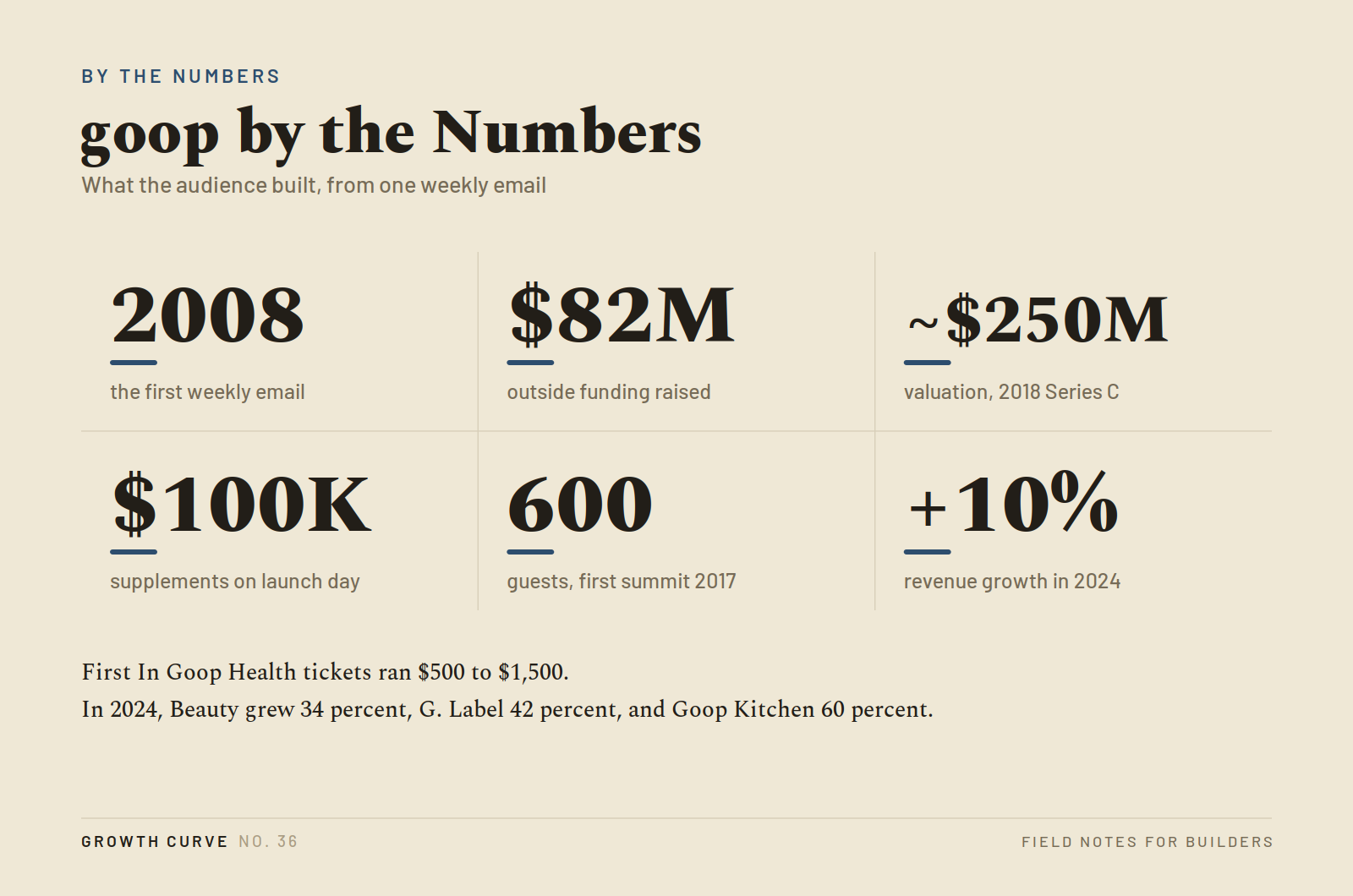
Outside capital arrived only after the audience and commerce had been proven. Goop secured a $10 million Series A in August 2015 led by New Enterprise Associates, a $15 million Series B in 2016 with Felix Capital and 14W Venture Partners, and a $50 million Series C in March 2018 with Lightspeed Venture Partners, reaching a reported $250 million valuation. The company had about 80 employees in 2017 and grew into a 200-person enterprise. The funding paid for product development and a deeper direct-to-consumer operation.
Netflix
In 2017, Goop claimed health benefits from inserting a $66 jade egg, which led the California Food, Drug, and Medical Device Task Force to investigate. In September 2018, Goop agreed to pay $145,000 in civil penalties over unsupported claims for its Jade Egg, Rose Quartz Egg, and Inner Judge Flower Essence Blend, and agreed to refund affected customers and to stop advertising the products as remedies. The attention did not slow the brand. In January 2020, Netflix launched The Goop Lab, a six-episode series hosted by Paltrow and chief content officer Elise Loehnen that covered topics ranging from energy healing to psychedelics, and it was renewed for a second season. Each wave of coverage sent new readers to the newsletter, which then sent them to the shops.
Where Goop Stands Now
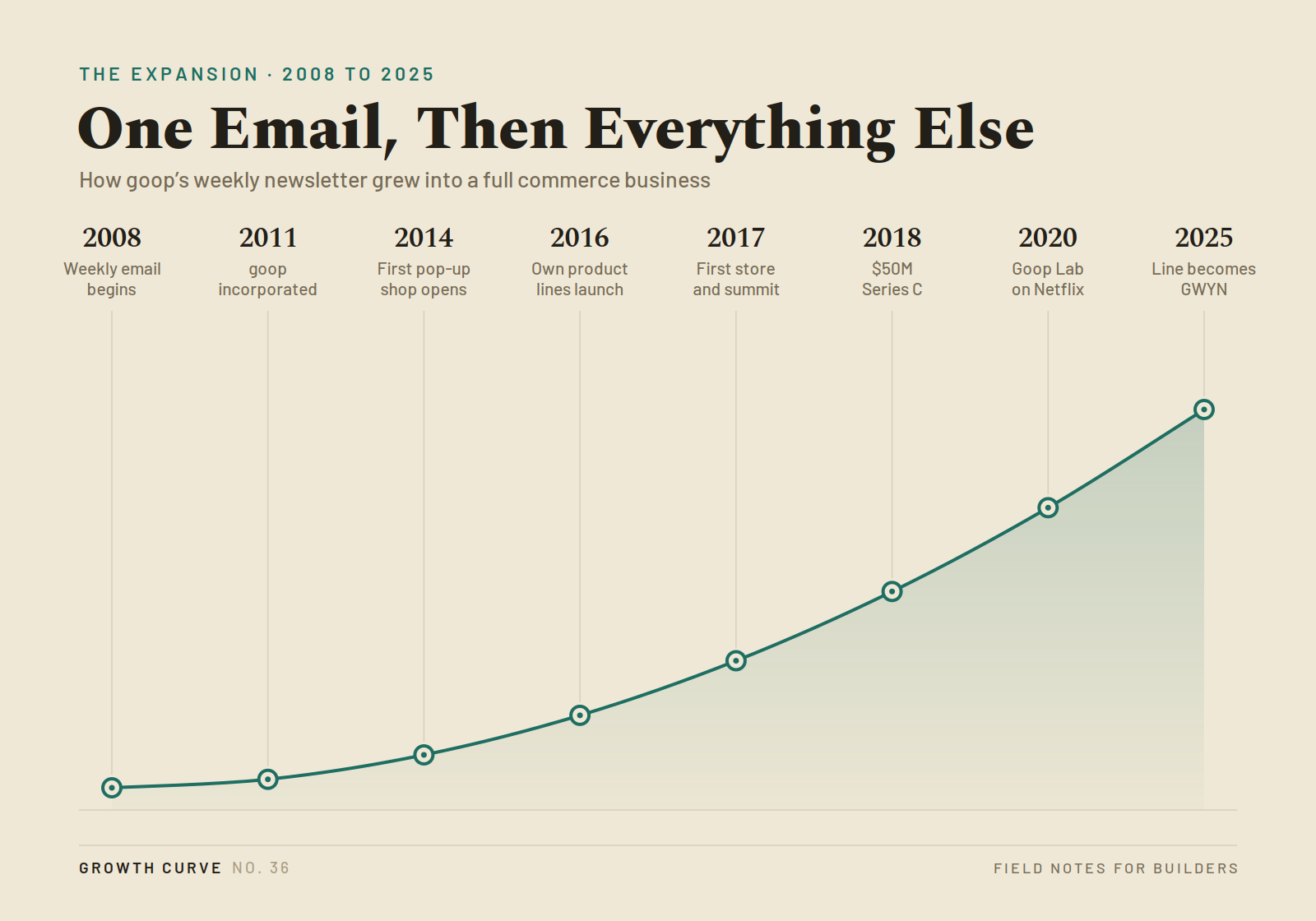
Goop has narrowed its focus to its strongest pillars. It reported 10% revenue growth in 2024 over the prior year, with its beauty category expanding by 40%, following workforce reductions and a focus on core lines. Paltrow confirmed ongoing revenue gains during a restructuring aimed at optimizing finances. In 2025, the clothing line G. Label was renamed GWYN and designed in close collaboration with Paltrow, made in Italy from high-end materials. The book imprint Goop Press, the Goop Podcast, and the Goop City Guides complete a brand that still channels every offering through the same editorial voice it started with.
Goop never used the newsletter to feed a business that existed elsewhere. The newsletter was the business. The product shelf, the storefront, the summit hall, and the streaming show were all formats for selling through a voice the audience trusted. The email did the work of a catalog, a flagship, and a sales floor at once, and it kept doing that work as every other channel was added on top of it.
Your newsletter won't build itself.


The 2000s Blog That Keeps Finding New Monetization Models
How Deadspin's Former Staff Built a Worker-Owned Media Company Without Outside Investors
Inside Puck’s Bet on Writer Ownership