Inside The Information's 13-Year Anti-Advertising Triumph

*** Every week, we pick apart how the world's best media brands got to where they are. This post is the long read. Growth Curve, our weekly newsletter, is the sharp version: same insight, shorter format, straight to your inbox. Subscribe free here. ***
In 2013, Jessica Lessin left a reporting job at The Wall Street Journal and launched a technology news site that charged $399 a year. She had spent about eight years covering Silicon Valley and the media industry at the paper, and she wanted to publish the kind of deeply reported story that insiders would pay to read. She financed the company with less than $1 million of her own money, kept full ownership through a firm she named Lessin Media Company, and hired her first reporter, Eric Newcomer, in 2014.
The Information launched without conventional advertising, and subscriptions were the sole source of revenue in the early days. The bet ran against the industry consensus of the moment, that online information had to be free, and that scale and advertising were the way to fund journalism. Lessin argued the opposite. In its thirteenth year, the publication runs a newsroom of dozens across several cities, breaks many of the largest stories in technology, and remains owned by the person who founded it.
Subscriptions Were the Core Business
From the first article, readers paid an annual fee that funded the reporting. The news articles carried no display or banner advertising and no native ads. The company has added other revenue over time, including brand partnerships, partner content, event sponsorships, and sponsored programming on its video show, while keeping the reporting itself free of advertising. Most of its reporting was available only to paying subscribers. The company also ran free newsletters, promotional offers, and 14-day trials on select newsletters, so parts of the operation reached readers who had not yet paid.
Lessin has described the business as aligned with subscribers, since the newsroom answers to the people who pay rather than to advertisers on its articles. To reinforce that independence, she built an early advisory board that included venture capitalist John Doerr, Politico co-founder Jim VandeHei, and ProPublica executive chairman Paul Steiger, and she kept the publication free of outside investment. The reporting earned a reputation for exposing the industry it covered, including the secret terms of venture deals and their implications for employees. Forbes reported in 2016 that The Information had broken news about deals worth more than $97 billion. By the company's own account, its stories have been followed by The Wall Street Journal, The New York Times, and Bloomberg thousands of times.
The Price Selected the Audience
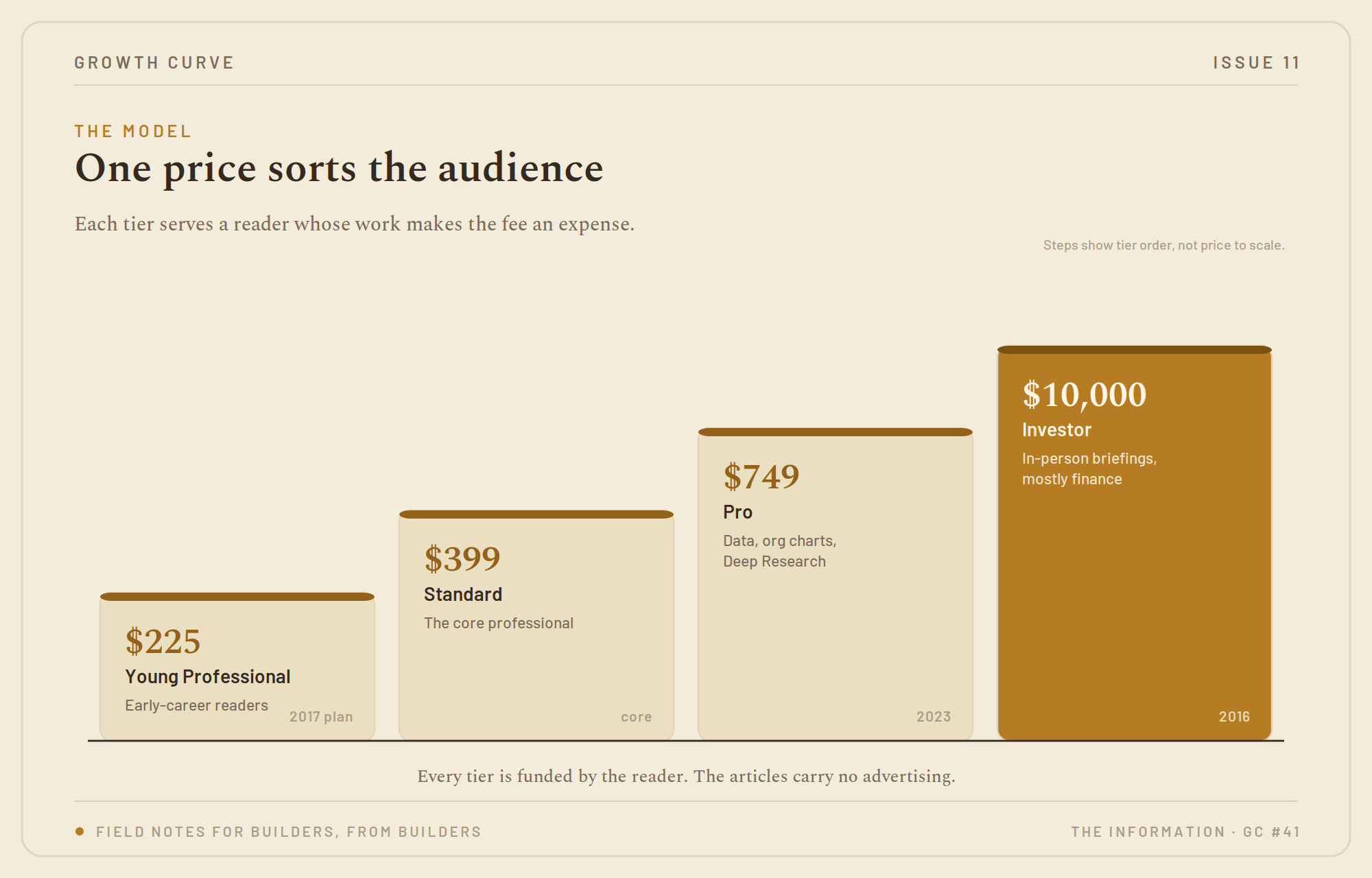
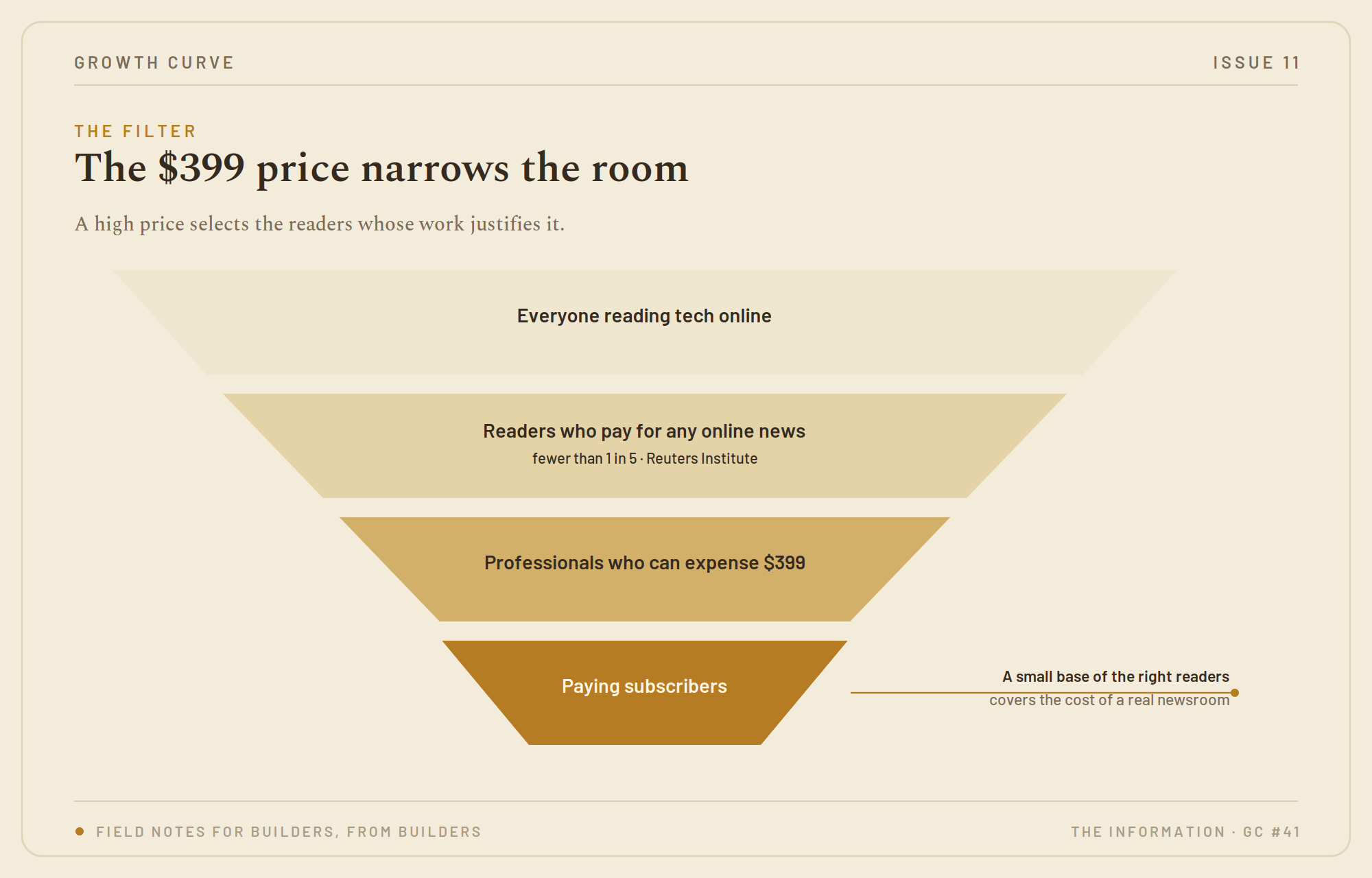
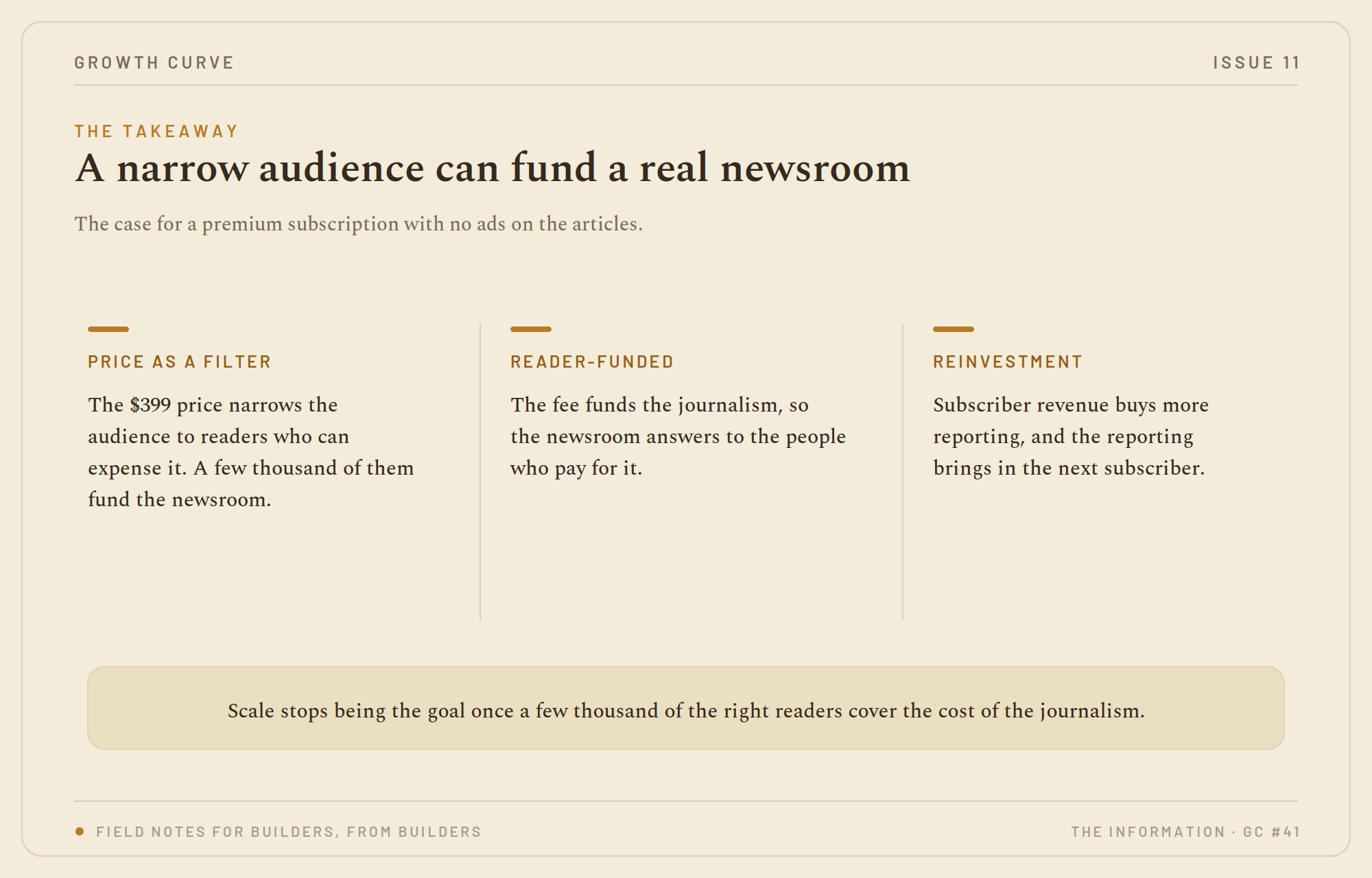
At $399 a year, the subscription cost far more than most readers were willing to pay for online news. The Reuters Institute has found that fewer than one in five readers across wealthy markets pay for any online news at all. That price sorted the audience down to the executive, the investor, or the operator whose work made the fee a business expense. About a third of the readership works in financial services. The Information layered other plans onto the years. In 2016, it offered a $10,000 investor membership whose main benefit was in-person briefings, which were mostly attended by people in finance. In 2017, it introduced a $199 Young Professional plan for early-career readers and a $749 All-Access plan. In 2023, it launched Pro, a data tier, at $999. The current pages list a $225 Young Professional plan and a $749 Pro plan, with standard and renewal rates ranging from $399 to $499.
Lessin has described the different tiers as a way to match price with value. Events follow a similar model, serving as subscriber benefits while also accepting corporate sponsorships. Tickets sell out within an hour. The Information opened an Asia bureau in Hong Kong under Shai Oster and has flown annual subscribers to networking events abroad, including a gathering in Beijing with leaders from companies such as Xiaomi and Hillhouse Capital. Lessin also founded the WTF Summit, an annual gathering for women in technology, media, and finance, and its seventh edition in 2025 brought together roughly 300 women.
Subscriptions Paid for More Reporting
The Information runs a loop. Reporting brings in subscribers, subscriber money pays for more reporting, and the deeper reporting brings in more subscribers. The company states that quality stories breed quality subscribers, and this formula scales better than chasing traffic. As the subscriber community grew, the company reinvested the proceeds in the team. The staff grew from a single reporter in 2014 to twenty-two by 2017. TechCrunch described The Information as holding the second-largest team of tech reporters in Silicon Valley.
Business Insider reported in 2022, citing people familiar with the company, that it had reached about 45,000 paying subscribers, and Vanity Fair put active readers, both paying and non-paying, at around 360,000 as of August 2022. The company has said its subscription revenue kept growing over that stretch, and it built a sponsorship and brand-partnership line that, by 2021, was expanding several times over year on year. Lessin has set the ambition high, saying she wants The Information to eventually spend as much on journalism as The Wall Street Journal or The New York Times, to build the next Wall Street Journal over the next fifty years, and to run the most impactful news organization of the next century. She has also grown a corporate subscription line, selling team access to companies whose employees need the coverage.
New Products Extended the Subscription Business
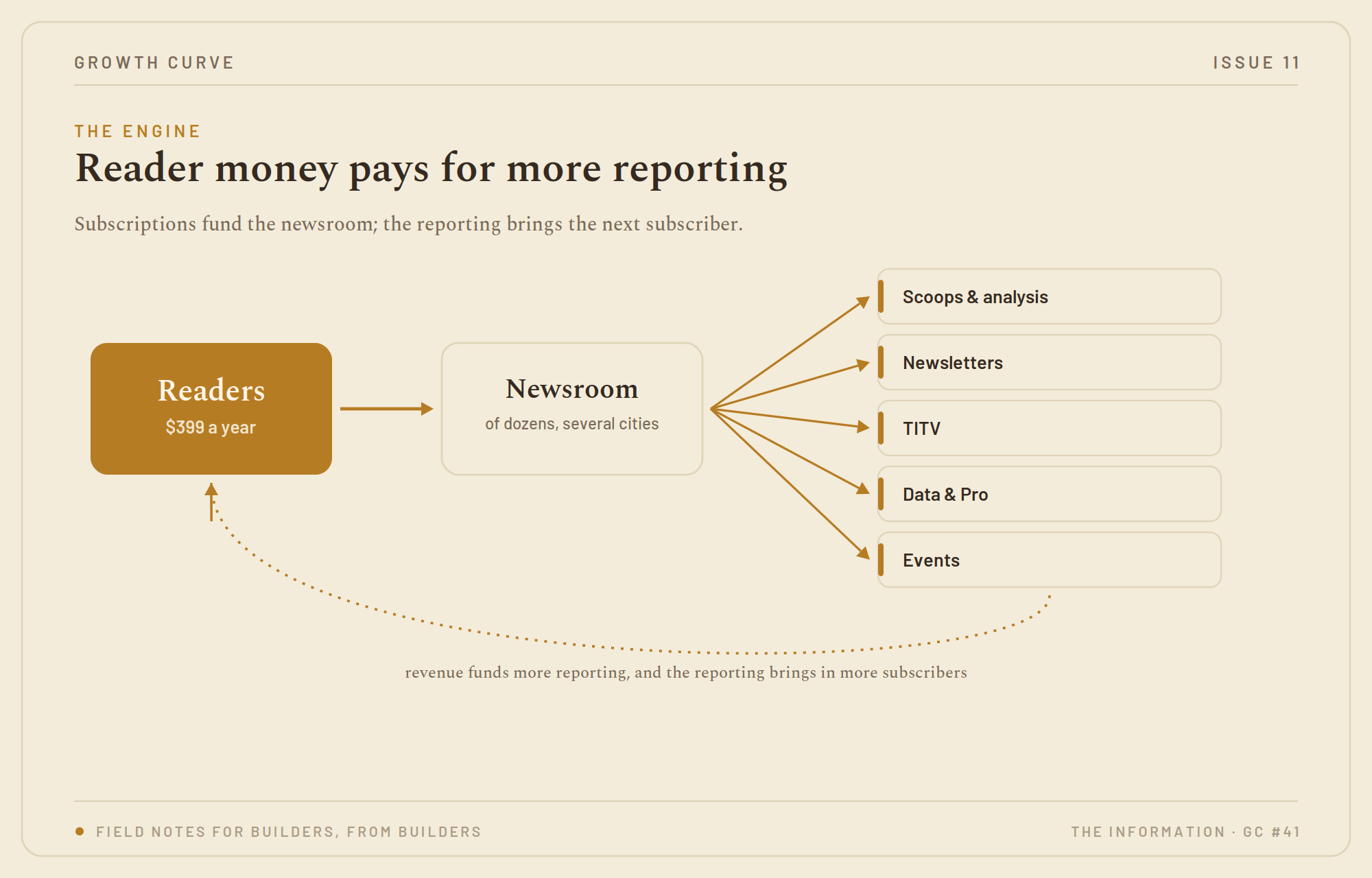
As the company added products, most of them were extensions of the subscription business. In 2020, it ran a bundle with Bloomberg Media, allowing readers to buy a year of both services. In 2021, it launched The Electric, a publication covering electric vehicles, which was initially sold as a separate subscription. Its newsletters are written by the reporters who break the stories, and the lineup now runs from the flagship Briefing to AI Agenda, Dealmaker, AI Infrastructure, Applied AI, and a weekend-long-form edition.
It built proprietary databases and industry org charts for the higher Pro tier, aimed at readers who wanted data alongside articles. In July, 2025, it launched TITV, a daily show that airs every weekday and reaches viewers on the site, the app, YouTube, and X. It also launched Deep Research, an AI tool that answers questions using more than a decade of the publication's reporting, organization charts, and proprietary data, built around material the company already owns. Each addition gave existing subscribers another reason to keep paying and gave prospective ones another reason to start.
Where The Information Stands Now
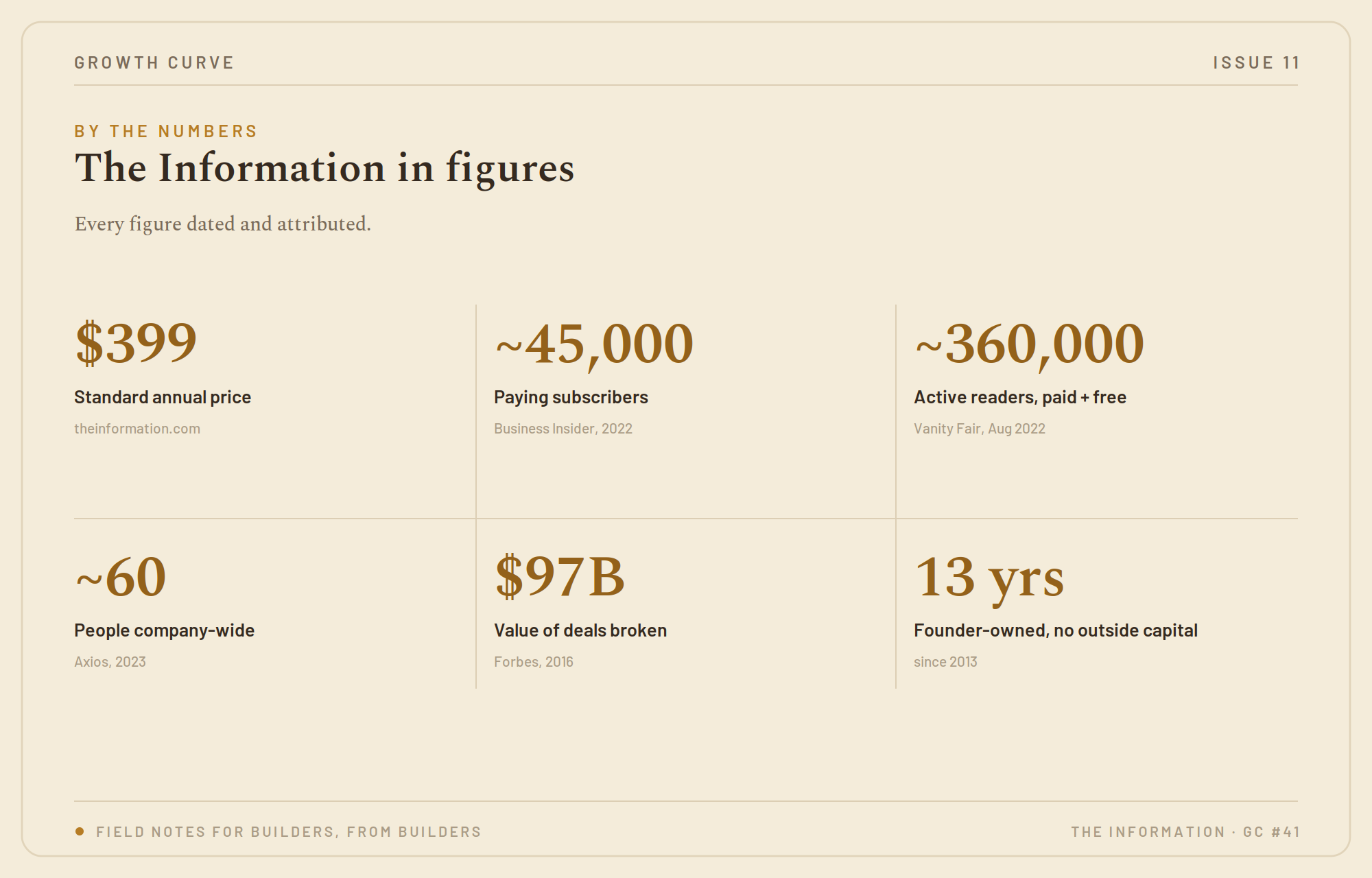
In 2026, the product leans heavily toward artificial intelligence, with several newsletters and a research tool built around the AI beat, and TITV airing every weekday. The Pro tier bundles the data products and the AI research tool for readers who want more than the reporting. The Information remains owned by Lessin, with no venture capital and no corporate parent, in its thirteenth year.
Separately, Lessin Media has taken stakes in other media companies, including Semafor and The Ankle. The company has described its aim as building the most impactful news organization for the next century, and its model has become a reference point for a wave of subscription publishers covering narrow professional beats. The subscription that once paid for a single reporter now funds a newsroom of dozens, a slate of newsletters, a daily show, a data business, and an AI product, with readers funding most of what it produces.
-------
*** Every week, we pick apart how the world's best media brands got to where they are. This post is the long read. Growth Curve, our weekly newsletter, is the sharp version: same insight, shorter format, straight to your inbox. Subscribe free here. ***
------------
Your newsletter won't build itself.


The 2000s Blog That Keeps Finding New Monetization Models
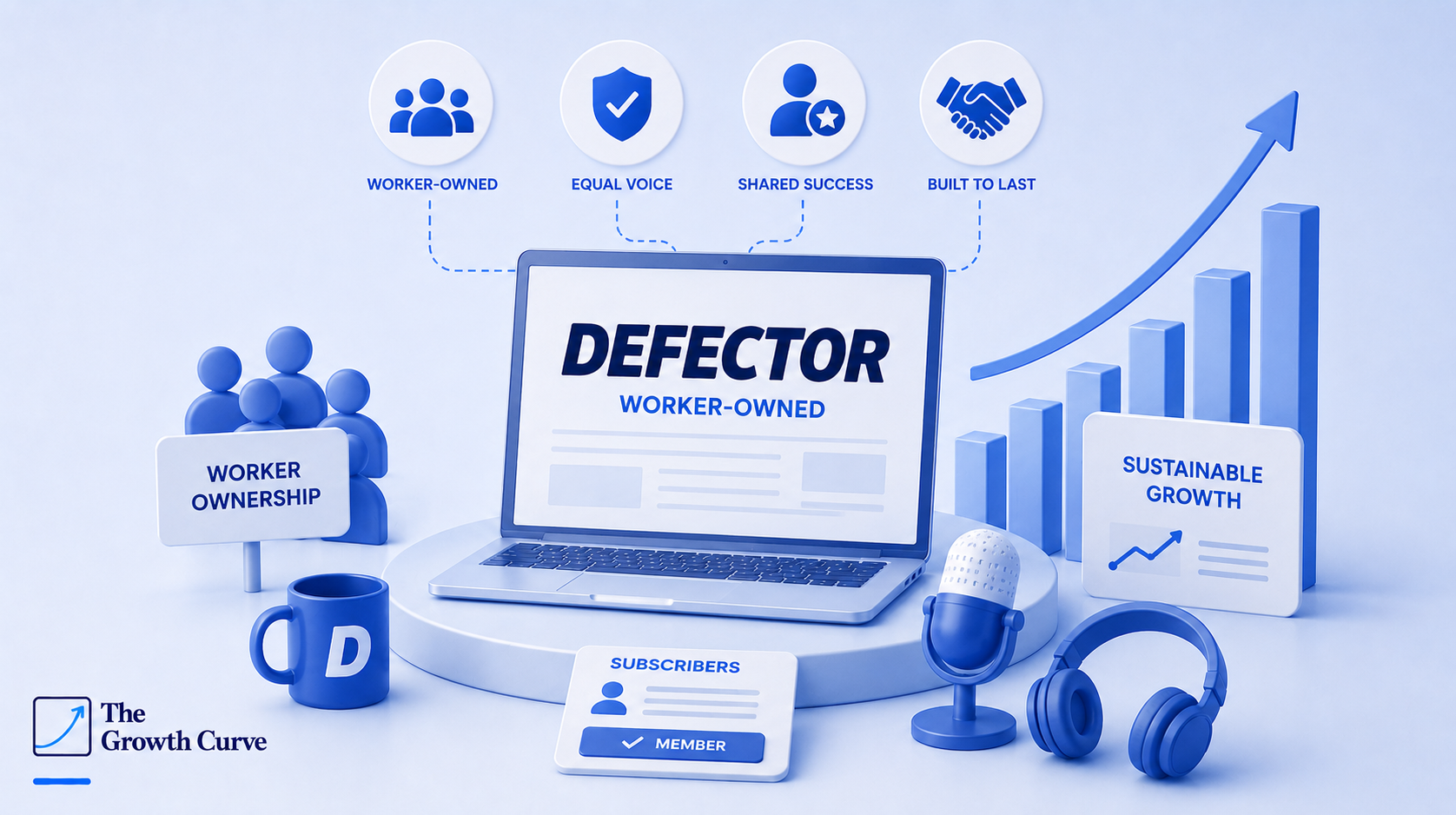
How Deadspin's Former Staff Built a Worker-Owned Media Company Without Outside Investors
Inside Puck’s Bet on Writer Ownership