Inside Puck’s Bet on Writer Ownership

*** Every week, we pick apart how the world's best media brands got to where they are. This post is the long read. Growth Curve, our weekly newsletter, is the sharp version: same insight, shorter format, straight to your inbox. Subscribe free here. ***
In April 2021, Jon Kelly announced a media company that had been in the works for months. Kelly had worked as an editor at The New York Times and Bloomberg and founded The Hive at Vanity Fair under Graydon Carter. After leaving Vanity Fair, he worked as an executive-in-residence at TPG on media investments. The name is a nod to Shakespeare's Puck and to the Puck Building in Manhattan, where Carter co-founded Spy magazine in the 1980s. Kelly's co-founders were Joe Purzycki (who co-founded the podcast company Luminary), Max Tcheyan, an early employee of The Athletic, and Liz Gough, a Condé Nast executive. Before launch, the company raised a $7 million Series A led by 40 North Media, affiliated with Standard Industries, and TPG Growth.
Puck launched in September 2021 with four verticals covering Wall Street, Washington, Silicon Valley, and Hollywood, and a roster of founding writers that included Matthew Belloni, Julia Ioffe, William D. Cohan, Dylan Byers, and Peter Hamby. Nearly five years later, Puck has more than 100,000 paying subscribers, was on track to exceed $20 million in revenue in 2025, and has expanded further through its acquisition of Air Mail. Its growth shows how a compensation model built around salary, equity, and subscriber-linked bonuses can shape both the newsroom and the business.
Writers as Shareholders
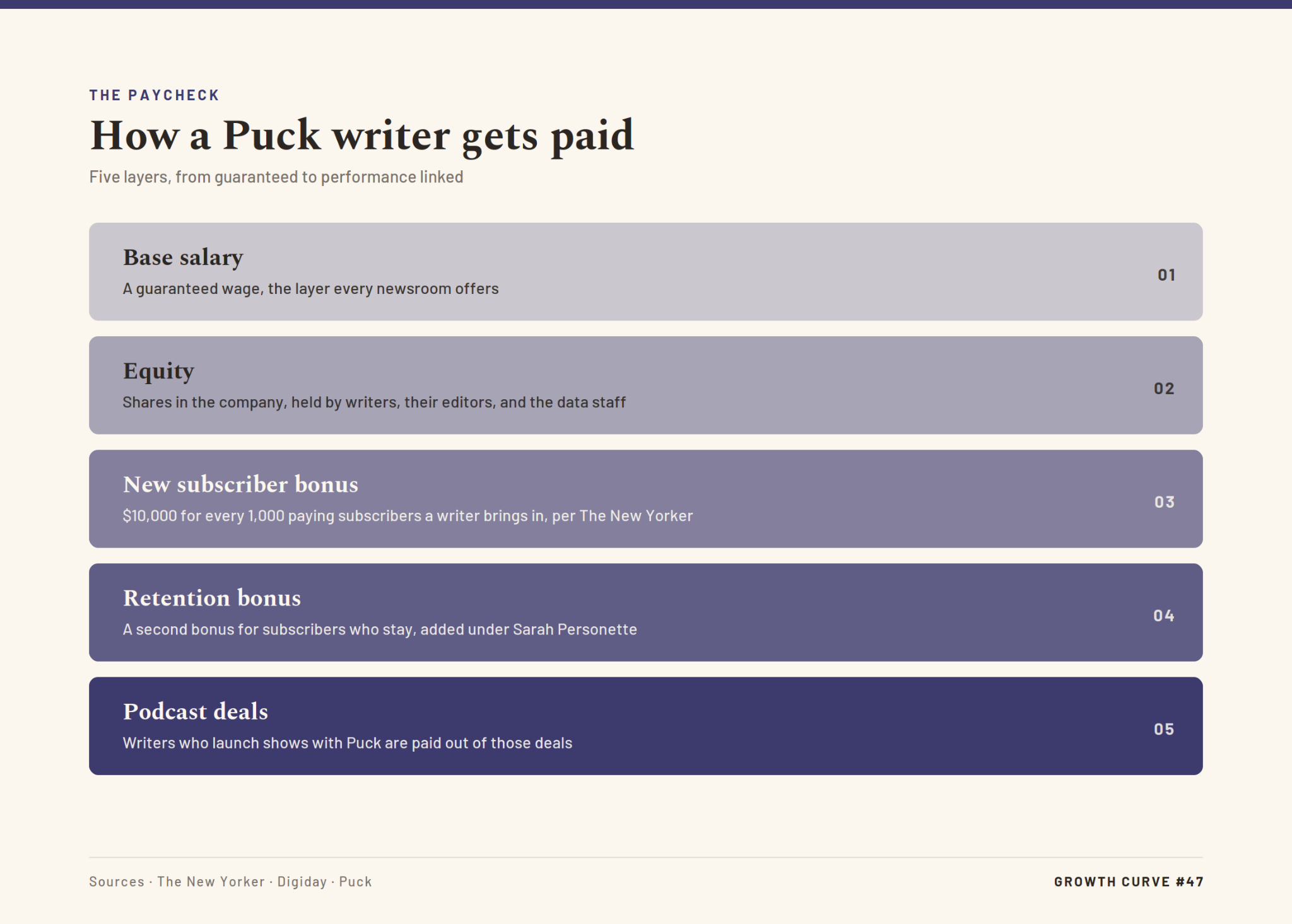
Puck's writers received a base salary, an equity stake in the company, and a bonus tied to the paying subscribers their work attracted. The New Yorker reported in 2022 that the bonus was $10,000 for every 1,000 subscribers a writer brought in, and that some Puck writers earned between $300,000 and $400,000 a year. Cohan, a former Wall Street banker who had already written six books, wrote in his first Puck piece that the equity was shared by the writers, the editors who edit them, and the data staff who track performance.
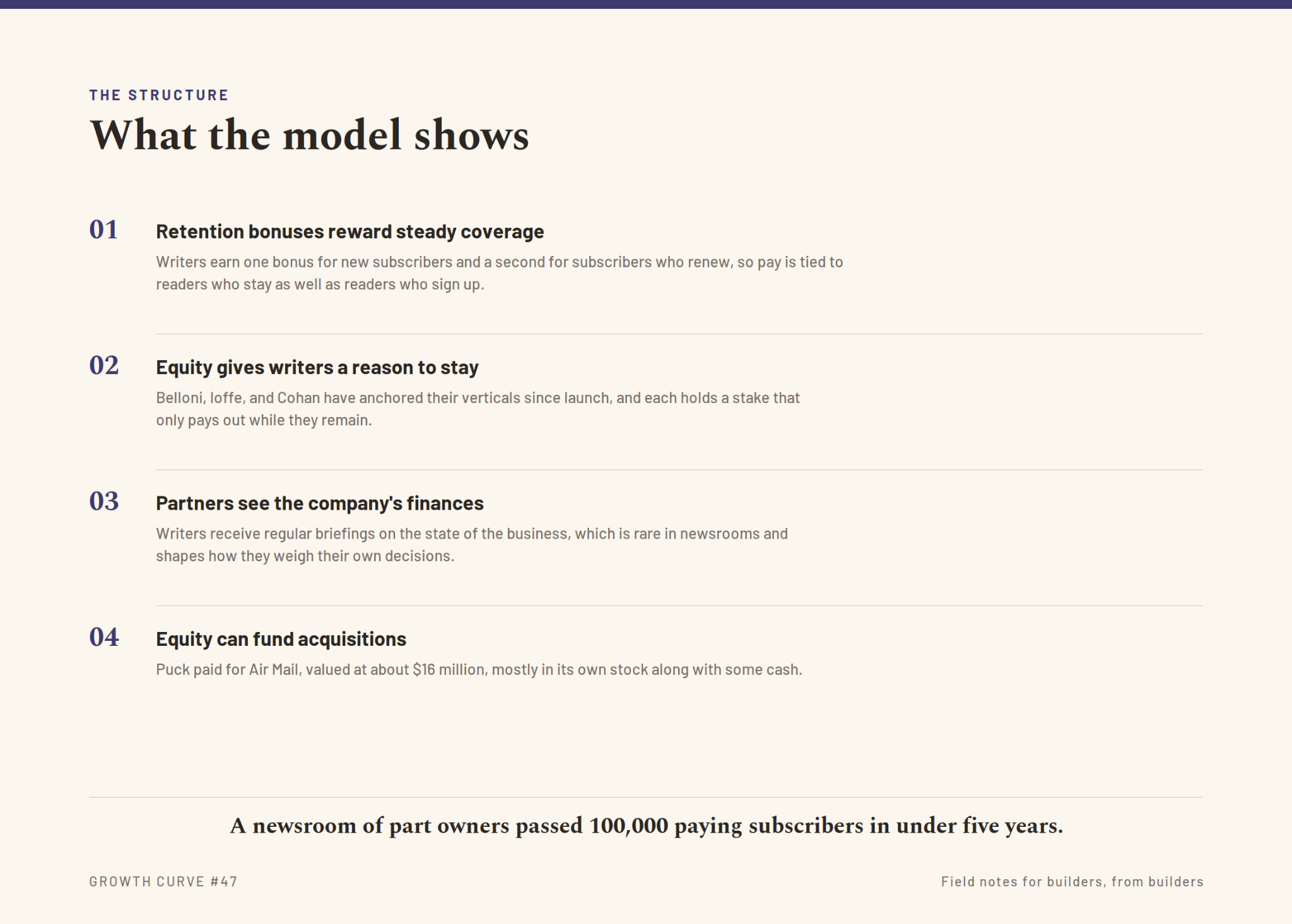
The structure has since gained a second layer. In a March 2025 interview with Digiday, chief executive Sarah Personette said writers receive one bonus for new subscribers and a second for subscribers they retain, tying pay to lifetime value as well as sign-ups. Writers who launch podcasts with Puck are paid out of those deals as well. When John Heilemann joined as chief political columnist in April 2024, he entered the same profit-sharing structure as every other partner. Following the Air Mail acquisition, Puck kept the same ownership and bonus structure across the combined company.
Partners also receive detailed briefings on the state of the business, an unusual arrangement in an industry where writers typically have a dim view of the balance sheet. Puck's journalists serve as its influencers, and the company profits by combining their reach with its opportunities.
Franchises Built Around Names
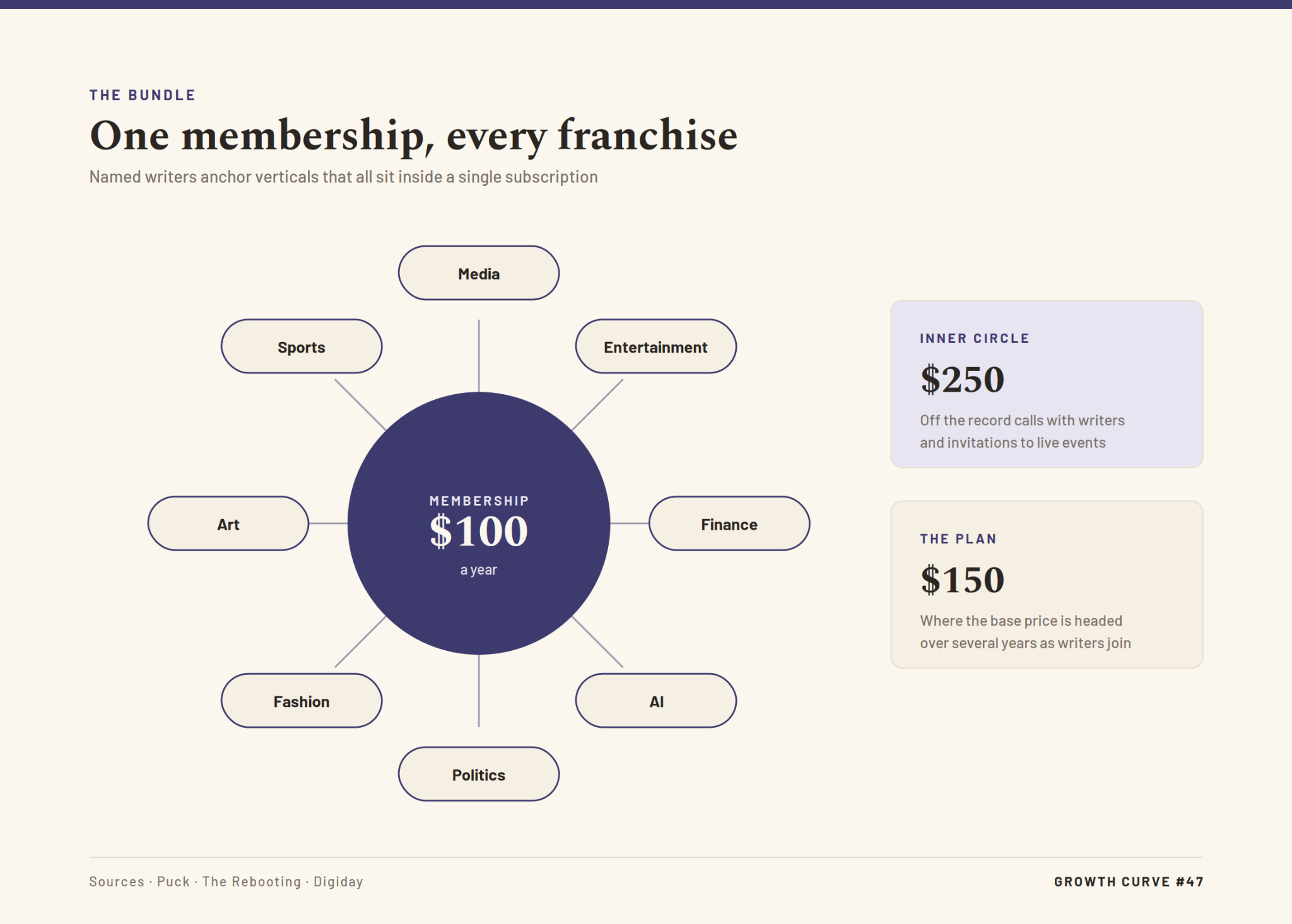
Readers could follow individual franchises such as Matthew Belloni’s What I’m Hearing on Hollywood, Julia Ioffe’s Washington coverage, and William D. Cohan’s Dry Powder on finance, all bundled within a single Puck membership. A regular membership cost $100 a year at launch and included every newsletter, the archive, and the podcasts. An Inner Circle tier at $250 a year added off-the-record calls with writers and invitations to in-person events. In January 2026, Personette told The Rebooting that new subscribers still pay $100, that the company plans to step that price toward $150 over several years as it adds writers, and that Inner Circle remains around $250.
By 2025, the individual newsletters had grown into franchises with contributors. Belloni's newsletter added legal writer Eriq Gardner and former Hollywood Reporter editor-at-large Kim Masters. Lauren Sherman's fashion newsletter Line Sheet added retail writer Sarah Shapiro and beauty journalist Rachel Strugatz. The company now pays bonuses to contributors within a franchise as well as to the anchor writer. The verticals expanded to cover media, entertainment, finance, AI, politics, fashion, art, and sports.
The Numbers
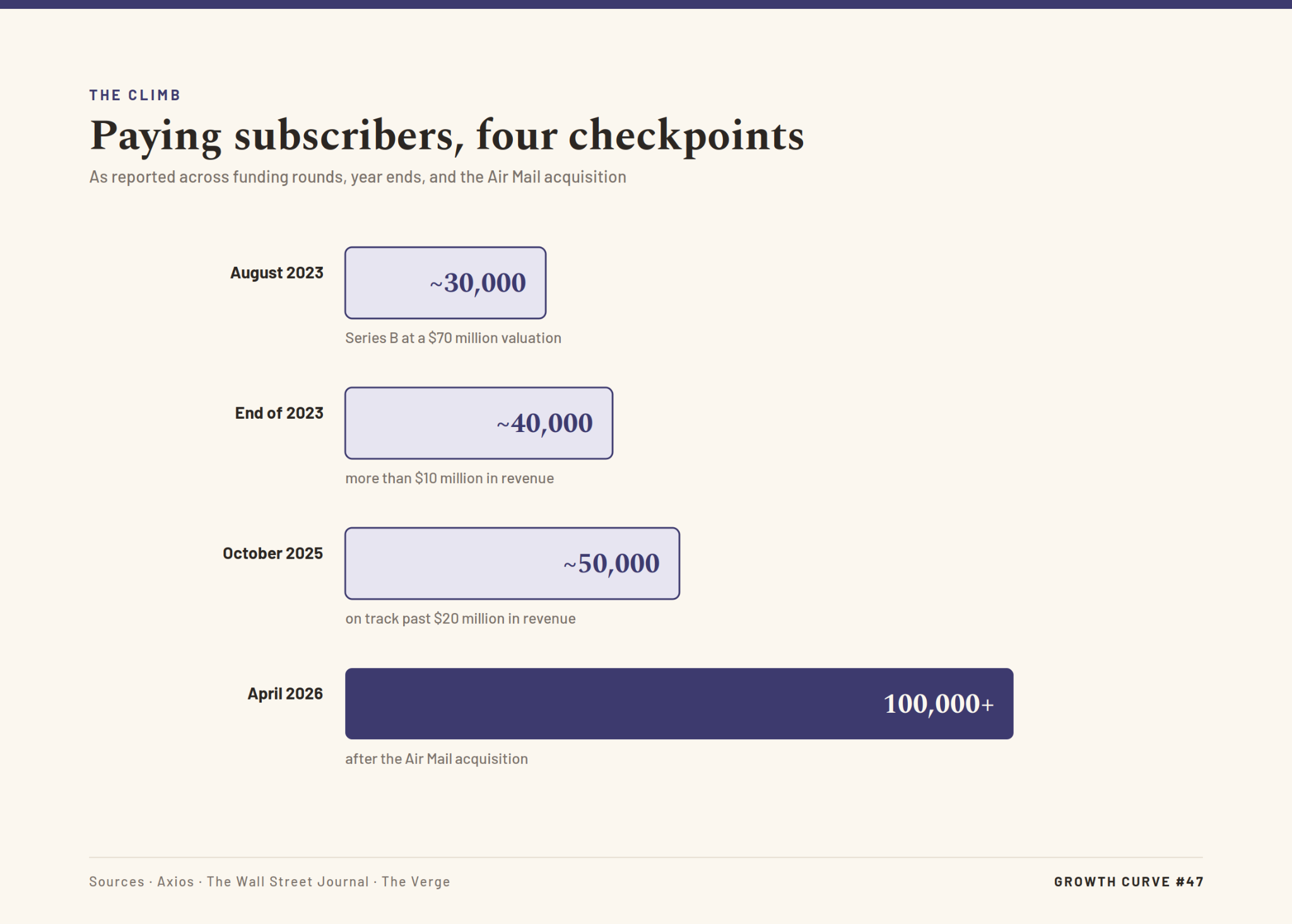
By November 2022, Puck had 25 staff members and 200,000 email subscribers. In August 2023, the company raised a Series B led by J Rothschild Capital Management, valuing the company at around $70 million. Puck had roughly 240,000 total subscribers, including about 30,000 paying subscribers. The Wall Street Journal reported that Puck ended 2023 with nearly 40,000 paying subscribers and more than $10 million in revenue.
Purzycki stepped down as chief executive in May 2023. Personette, who had run ad sales at Twitter and earlier led global business marketing at Facebook, was named chief executive in January 2024. By March 2025, Puck's paying subscriber base had grown 30% over the previous year. In October 2025, Axios reported that Puck was on track to exceed $20 million in revenue for the year, with the majority coming from advertising and sponsorship, and that the company had nearly 50,000 paying subscribers and was still unprofitable.
That same month, Puck completed its acquisition of Air Mail, the digital publication Graydon Carter founded in 2019. The New York Times reported that the deal was valued at about $16 million and paid mostly in stock, with some cash. In an April 2026 interview, Personette said that following the Air Mail acquisition, Puck had passed 100,000 paying subscribers. She said subscription revenue grew by more than 50% in 2025, advertising revenue grew by more than 35%, total revenue grew by 40%, and the company is very close to profitability.
The Trade-Off Between Ownership and Independence
Substack lets a solo writer keep roughly 90% of subscription revenue before payment-processing fees, but the writer also carries the full cost of running the business. Puck offers a different trade-off: salary, editorial support, sales, events, podcasts, and equity in exchange for working inside a larger organization. Tara Palmeri tested both models. After joining Puck in 2022, she left in March 2025 to launch her own YouTube channel and Substack, later saying Puck had brought her closer to writing directly for an audience but that its editing pushed her voice toward a more polished, insider-oriented style than she wanted.
The equity adds upside, but its value is still uncertain. Puck does not pay dividends, and the company has not outlined an exit plan. The Air Mail acquisition showed that Puck shares can be used as transaction currency, but for writers, those shares only become cash if the company eventually creates a liquidity event.
Where Puck Stands Now
Puck operates from a 10,000-square-foot newsroom at Trinity Commons in Manhattan, with reporting teams in Washington and Los Angeles. The company acquired the art-market newsletter Artelligence in April 2024 and folded it into the art vertical. Its podcast slate includes The Powers That Be and Impolitic with John Heilemann, produced with Audacy, and The Town, produced with The Ringer. Summits such as In the Arena for sports and The Art of Influence for the art market draw 100 to 125 attendees, with tickets priced at $1,500 to $2,000 each. Advertising and sponsorship now account for the majority of revenue, while subscription revenue is growing rapidly.
Puck makes a strong case for writer ownership as a media business model. Equity and subscriber-linked bonuses give journalists a financial stake in both attracting and retaining readers, while the company provides the infrastructure that independent writers would otherwise have to build themselves. The results are visible in the retention of major talent and growth in paid subscriptions.
Puck does not prove that equity automatically produces better journalism, but it shows that ownership can materially change the incentives around how writers build an audience and how long they stay.
*** Every week, we pick apart how the world's best media brands got to where they are. This post is the long read. Growth Curve, our weekly newsletter, is the sharp version: same insight, shorter format, straight to your inbox. Subscribe free here. ***
Your newsletter won't build itself.