How Robinhood Built and Consolidated Its Media Arm

*** Every week, we pick apart how the world's best media brands got to where they are. This post is the long read. Growth Curve, our weekly newsletter, is the sharp version: same insight, shorter format, straight to your inbox. Subscribe free here. ***
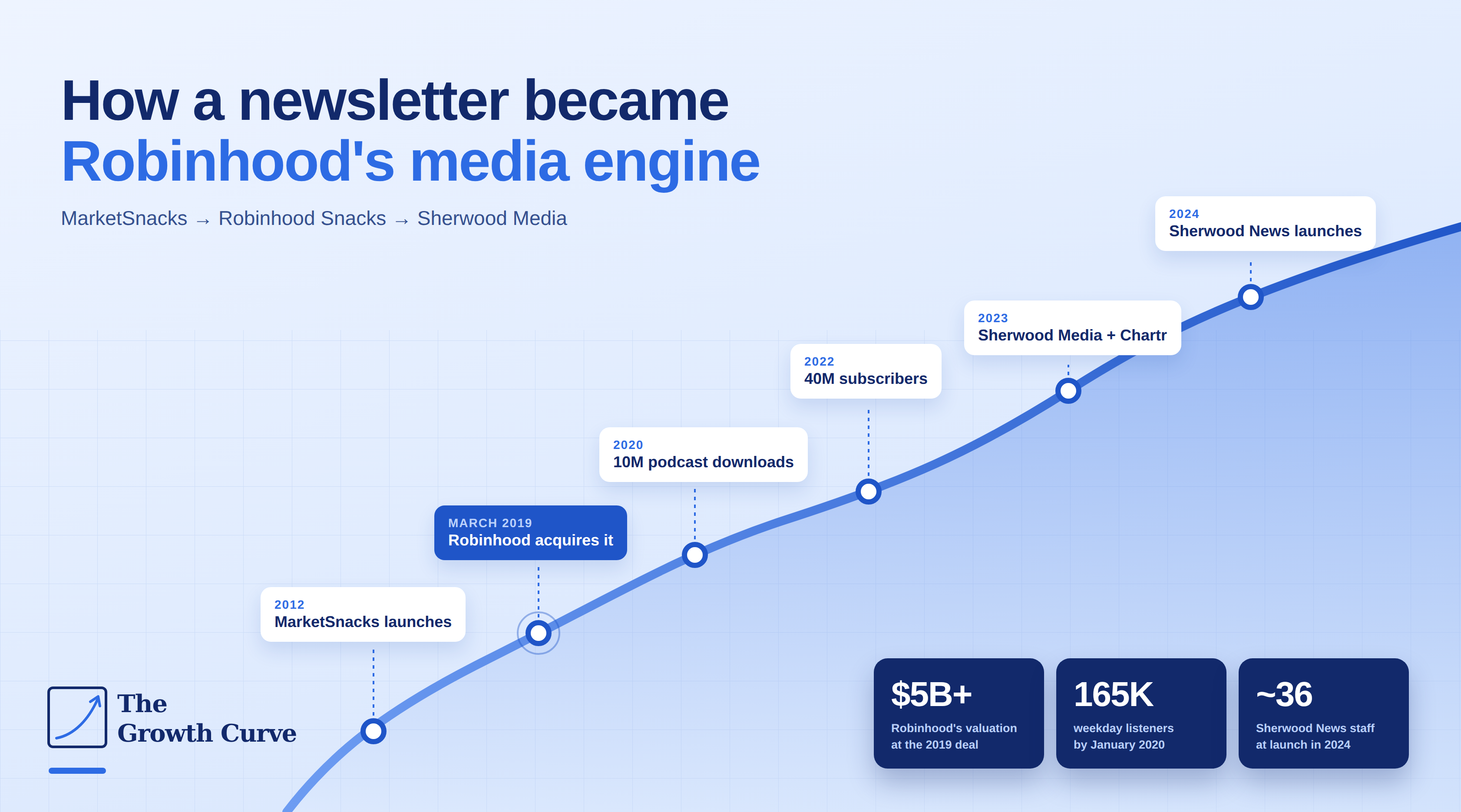
In 2012, two former college roommates started writing a daily financial newsletter outside their bank jobs in New York. Jack Kramer worked at Commerzbank, and Nick Martell worked at UBS. The two had met as freshman roommates at Middlebury College. They called the project MarketSnacks. Each morning, the newsletter broke down three to four business stories in plain language with a sense of humor. 7 years later, the stock-trading app Robinhood acquired the company. It was Robinhood's first acquisition, and it became the seed of a media operation that would eventually span multiple newsletters, a podcast franchise, a second acquisition, and a standalone news organization.
How MarketSnacks Reached Young Financial Readers
MarketSnacks grew slowly through its first years. Kramer and Martell wrote in their off hours, kept the tone conversational, and aimed the product at readers in their twenties who found traditional financial media dense and joyless. According to Fortune, 85% of subscribers were under 36. The company added a daily podcast alongside the newsletter and signed syndication deals with Fidelity and Betterment. The project also drew early backing from Rough Draft Ventures, a student-focused venture fund, and by 2019 the subscriber count was reportedly in the six figures. While the audience was modest by media industry standards, its composition made it valuable. MarketSnacks had built an audience of young readers that brokerages were investing heavily to attract.
The Acquisition That Gave MarketSnacks National Distribution
In March 2019, Robinhood announced it had acquired MarketSnacks. Fortune reported it was the company's first acquisition, made when Robinhood was valued at more than $5 billion and served more than 6 million users. Terms were undisclosed. Josh Elman, Robinhood's vice president of product, said it was part of a year-long effort to build out market news resources for the app's users. The newsletter was rebranded as Robinhood Snacks, the podcast became Snacks Daily, and Kramer and Martell joined as managing editors of news, relocating from New York to Silicon Valley.
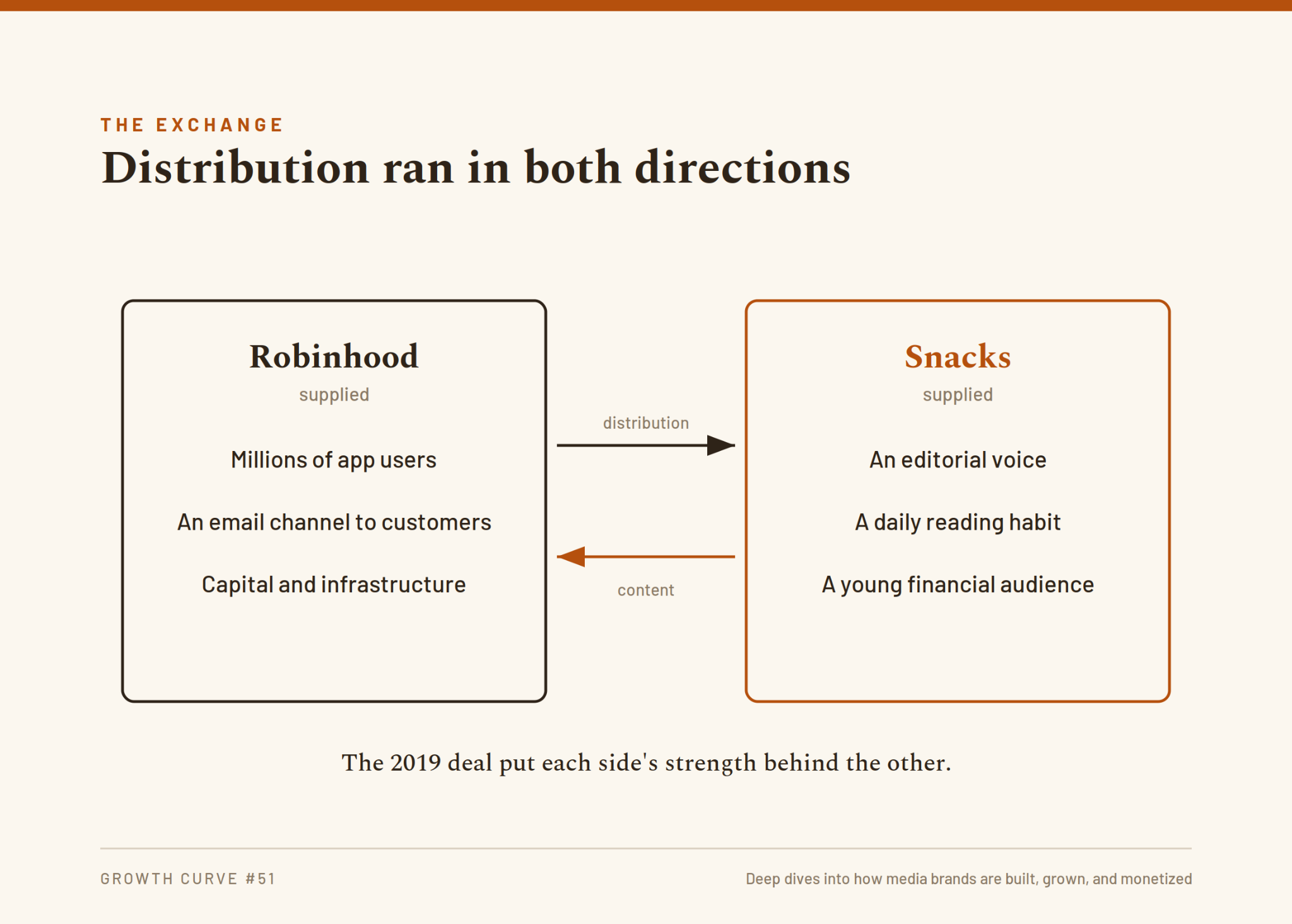
The logic of the deal was bidirectional distribution. Robinhood gave Snacks access to millions of app users who wanted digestible market news. Snacks gave Robinhood an editorial voice. By January 2020, Robinhood announced that Snacks Daily had passed 10 million downloads, ranked third in Apple's Business News category, and together with Snacks Minute, its shorter companion show, reached more than 165,000 listeners every weekday. Snacks Minute also consistently ranked among Spotify's top 10 podcasts at the time. In September 2020, the brand expanded into a video series on Instagram and YouTube.
Robinhood incorporated Snacks into its customer email communications, allowing newsletter distribution to expand as the brokerage's user base grew. When millions of new customers joined Robinhood during the retail trading boom of 2020 and 2021, the newsletter's reach grew with them. By April 2022, Robinhood said Snacks had reached 40 million subscribers, per Axios.
From Robinhood Snacks to Sherwood Media
In April 2022, Kramer and Martell left Robinhood and relaunched the podcast independently as The Best One Yet, with Robinhood initially serving as its exclusive sponsor. Chief executive Vlad Tenev told employees that the company would help establish the new venture while maintaining a close relationship with the founders. Their departure ended the first phase of Robinhood’s media strategy.
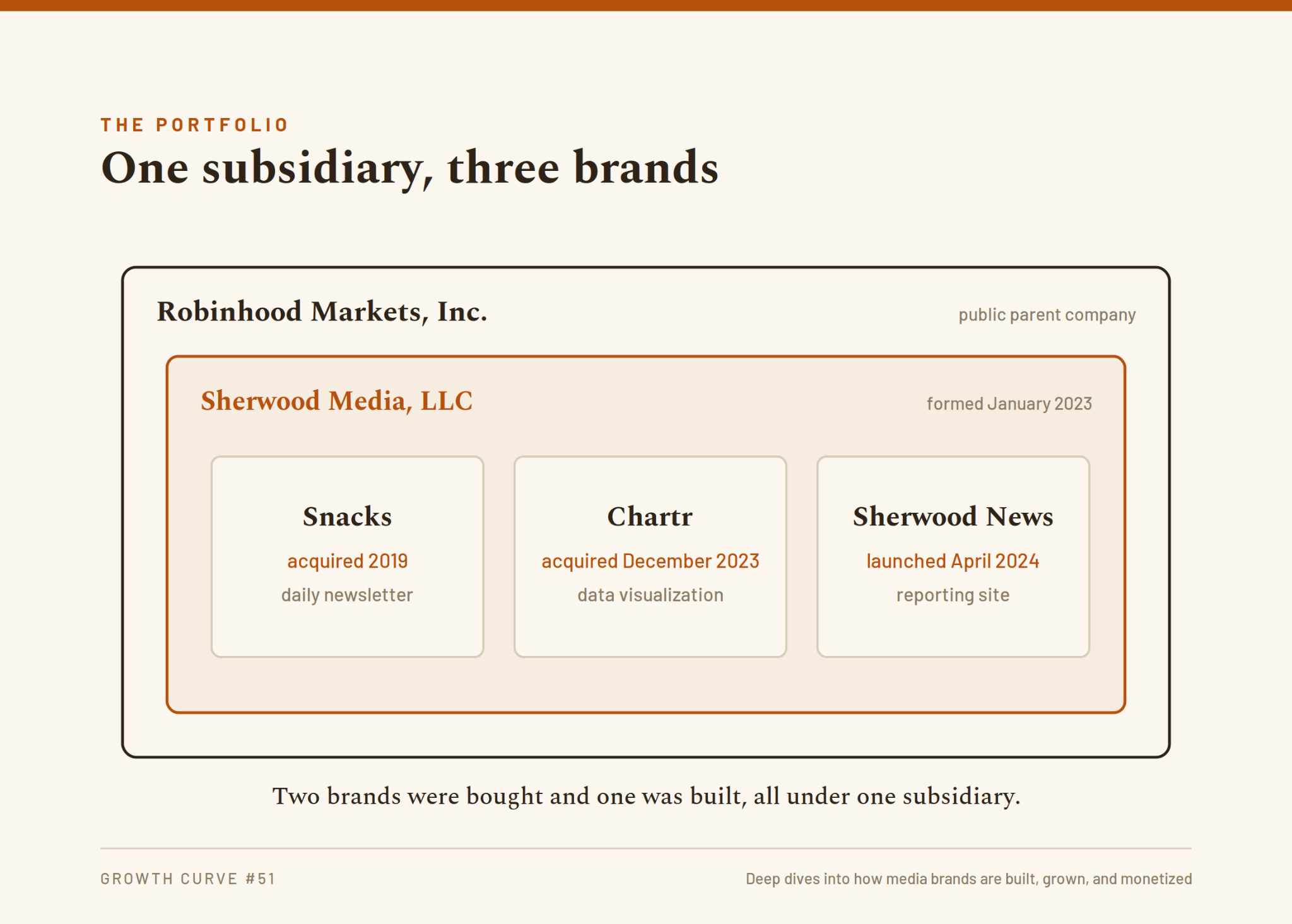
In January 2023, Robinhood announced the formation of Sherwood Media, LLC, a wholly owned subsidiary built on top of Snacks. The company said tens of millions of people read Snacks each week and described Sherwood Media as a home for news about markets, economics, business, technology, and culture. To run it, Robinhood hired Joshua Topolsky, the founder and former editor-in-chief of The Verge, a co-creator of Vox Media, and the former chief digital content officer at Bloomberg. Topolsky became president and editor-in-chief of Sherwood. By June 2023, Axios reported that Sherwood planned to expand into events, podcasts, and a print magazine, and had hired a head of sales to begin building an advertising business.
Robinhood Repeats the MarketSnacks Playbook
On December 21, 2023, Robinhood acquired Chartr Limited and added it to the Sherwood Media portfolio. Chartr was a London-based publisher founded in 2018 and told business stories through data visualizations. Chartr had grown to around 500,000 newsletter subscribers with a team of about six people. Axios reported that Chartr would remain a standalone brand under Sherwood, while its visual storytelling would be integrated into Snacks, Sherwood's web products, and its social channels.
In April 2024, Sherwood launched Sherwood News, with original reporting across markets, business, tech, crypto, power, and culture. Topolsky told Axios the operation employed roughly 36 people, with teams in New York, California, and London. The site hired reporters from Bloomberg and The New York Times, ran without a paywall, and monetized through direct-sold advertising, with early advertisers including Apple and Nasdaq. Topolsky told Axios he wanted Sherwood News to become a revenue-driving business for Robinhood in its own right, with journalists free to cover the parent company, provided they make proper disclosures.
The Lasting Value of Robinhood’s Media Strategy
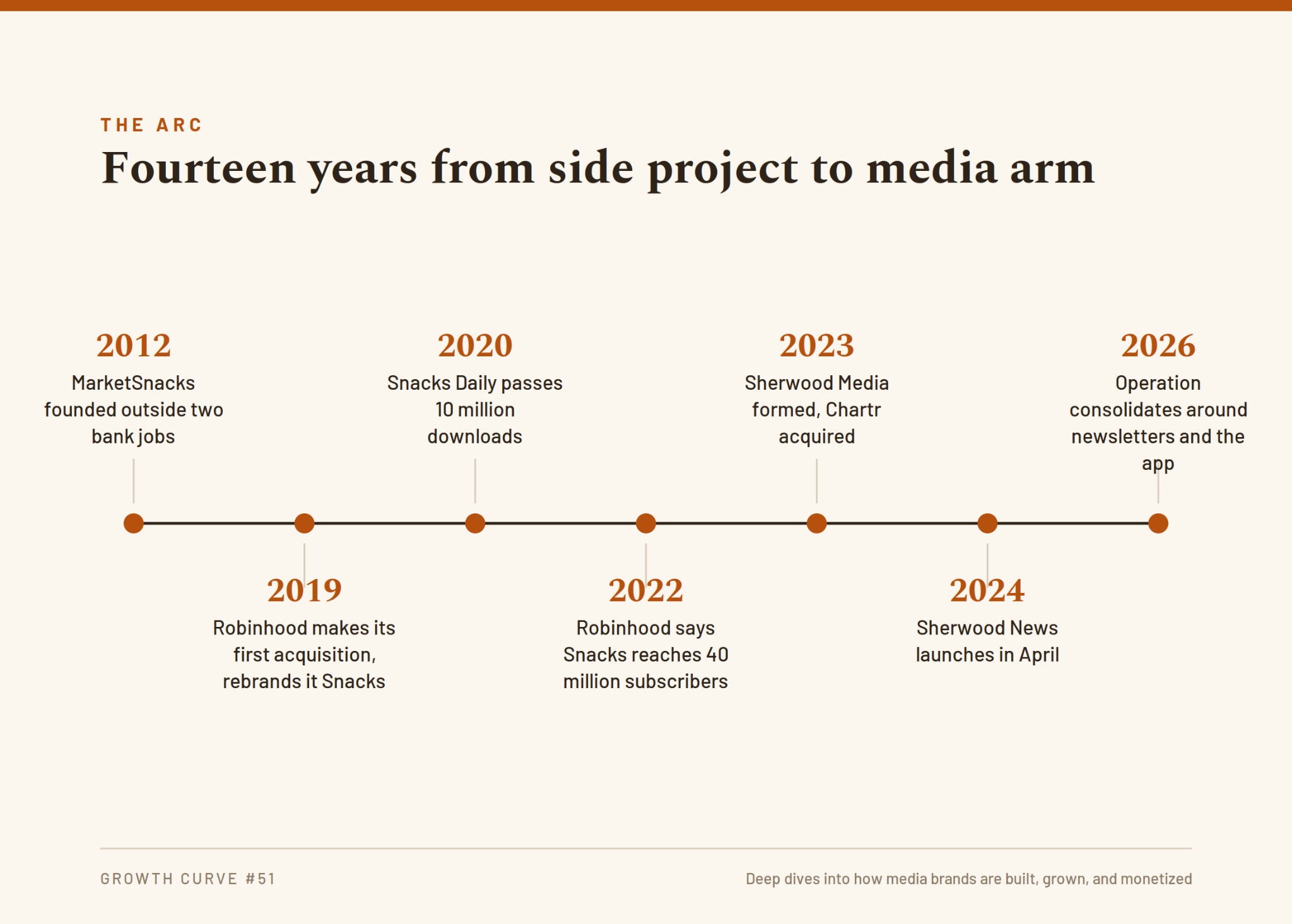
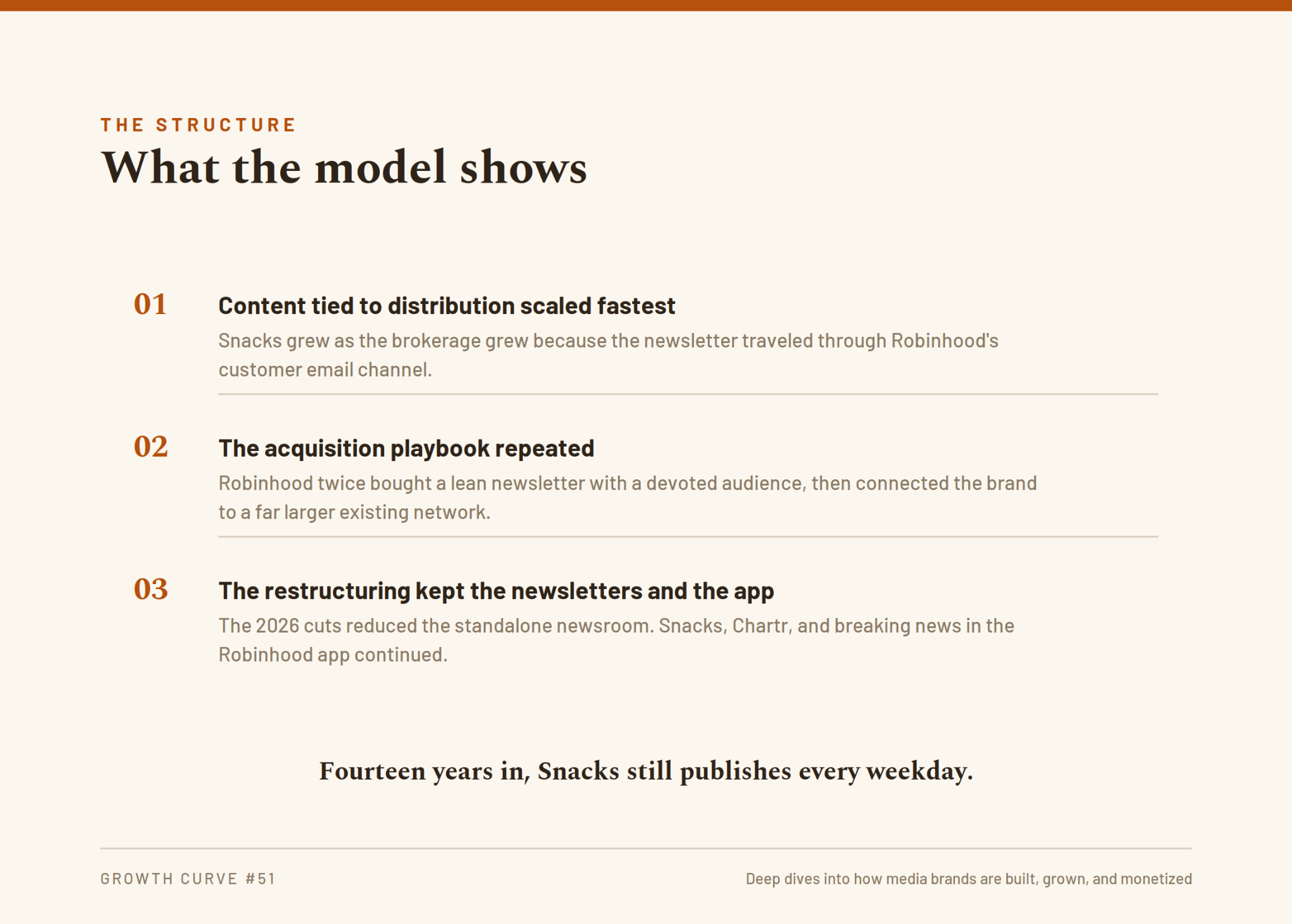
Business Insider reported a first round of layoffs at Sherwood in early 2025, which the company described as a move to streamline its team structure. In June 2026, Robinhood announced cuts across the company affecting approximately 10% of its workforce. The reductions also reached Sherwood's newsroom. Sherwood reduced its standalone newsroom and shifted its focus toward Snacks, Chartr, and breaking news for the Robinhood app. The Sherwood News website remained online with a smaller operation, while continuing to host original stories and the newsletter archives.
Over 7 years, Robinhood expanded from a newsletter acquisition into a broader media operation. It built a popular podcast, formed a media subsidiary, acquired Chartr, and launched an advertising-supported newsroom. After the 2026 restructuring, the company placed greater emphasis on its newsletters and breaking news delivered through the Robinhood app.
Robinhood’s media strategy worked best when content was connected directly to distribution. MarketSnacks brought a young financial audience, while Robinhood supplied millions of customers and an established email channel.
14 years after MarketSnacks launched, Snacks remains central to Robinhood’s customer distribution strategy. It reaches customers outside the trading app, explains market developments that may influence their activity, and gives Robinhood a consistent presence between trades and account checks. Its value comes from the direct connection between financial content, a large audience, and Robinhood’s core brokerage product. Robinhood’s media operation demonstrates how a company can leverage its existing customer base to scale its editorial products. That was the model Robinhood extended through podcasts, video, Chartr, and Sherwood News.
Introducing the Growth Curve Score
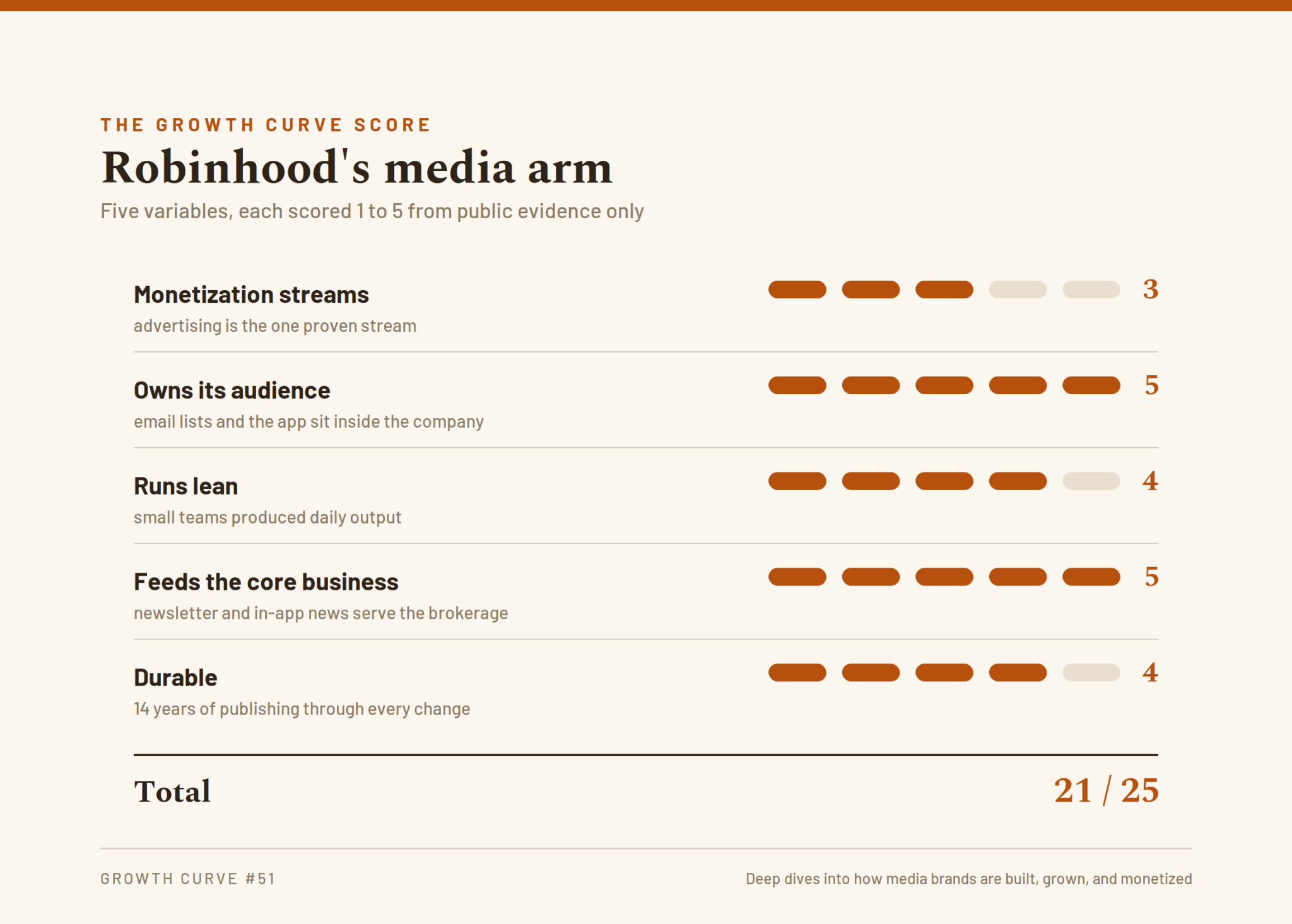
Starting today, we rate each media business we profile on five variables, each scored from 1 to 5 based solely on public evidence.
- Monetization Streams
- Owns Its Audience
- Runs Lean
- Feeds The Core Business
- Is Durable.
The five scores add up to a total out of 25.
*** Every week, we pick apart how the world's best media brands got to where they are. This post is the long read. Growth Curve, our weekly newsletter, is the sharp version: same insight, shorter format, straight to your inbox. Subscribe free here. ***
Your newsletter won't build itself.