Every’s Path From Newsletter Bundle to AI Product Studio

*** Every week, we pick apart how the world's best media brands got to where they are. This post is the long read. Growth Curve, our weekly newsletter, is the sharp version: same insight, shorter format, straight to your inbox. Subscribe free here. ***
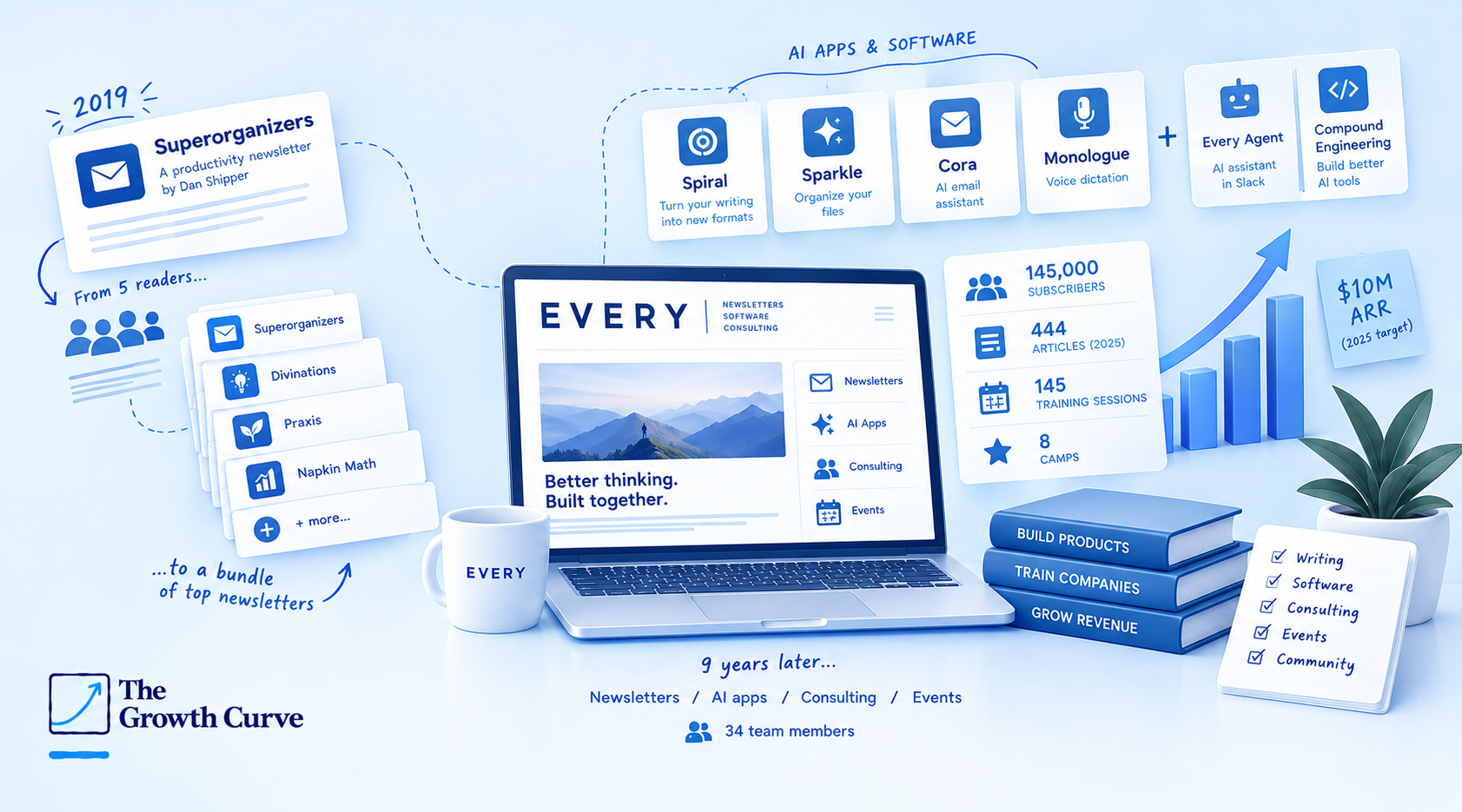
In 2019, Dan Shipper launched a productivity newsletter called Superorganizers. He planned to build productivity software and saw the newsletter as a way to reach people who might eventually use it. As a student at the University of Pennsylvania, he had co-founded Firefly, a co-browsing tool, with Justin Meltzer. Pegasystems acquired Firefly in July 2014, paying $2.3 million in cash. 7 years after Superorganizers launched, Every publishes a daily newsletter, runs a consulting arm, and has a team of 34, including staff and contributors. By September 2025, it had built four AI apps (Spiral, Sparkle, Cora, and Monologue) and has since expanded its software offerings with Every Agent and Compound Engineering.
Growing the Bundle Through Writer Partnerships
Superorganizers took off quickly, and Shipper told A Media Operator in September 2020 that its growth led him to think he could simply start newsletters. Nathan Baschez, Substack's first employee and a former head of product at Gimlet Media, wrote Divinations, a paid newsletter on business strategy that cost $20 a month. On April 13, 2020, Shipper and Nathan launched a bundle of both newsletters as a new Substack publication, priced at $15 a month for the first 24 hours and $20 after that. Later they called it the Everything Bundle. Revenue doubled overnight.
Tiago Forte brought his Praxis newsletter into the bundle for a six-month trial, and Adam Keesling added Napkin Math in June 2020, covering investment theses and business case studies. Lead writers typically received 50% of the subscription profit attributed to their publications. A sign-up survey asked readers which newsletter prompted them to pay, helping Every allocate that income. Writers could also leave with a copy of their email list, giving them a way to try the partnership while retaining access to their audience.
Leaving Substack
On January 26, 2021, Axios reported that the bundle had raised $600,000 in pre-seed funding led by Bedrock Capital and moved off Substack onto its own publishing platform. Indie Hackers reported that the founders had incorporated once the bundle reached $10,000 in monthly recurring revenue. Evan Armstrong took over Napkin Math that April and became one of the company's best-known writers.
By October 2021, Every had grown to 13 newsletters with approximately 2,400 paying subscribers and 36,000 free subscribers, according to Indie Hackers. The price was $20 a month or $200 a year. Direct traffic accounted for about 60% of the site’s 353,000 visits over six months. Every attracted new readers through word of mouth, Twitter, Hacker News, interviews, and cross-promotions with other newsletters.
Lex Leaves Every
In January 2023, Shipper wrote that he had spent several weeks using GPT-3 as a journal. That May, he wrote that Every was building chatbots that answered reader questions about its articles. Lucas Crespo, who ran ads and courses, built an article summarizer in Python and deployed it on Heroku in two days with no prior programming experience. Baschez incubated Lex, an AI writing app, inside the company.
On August 23, 2023, Every spun Lex out as a separate company. Baschez left to run it as chief executive, and raised a $2.75 million seed round from True Ventures. In July 2024, Shipper wrote that the company had gone through a very hard stretch beginning about a year earlier. Every’s paid subscribers retained free access to Lex’s paid plans.
Every Studio
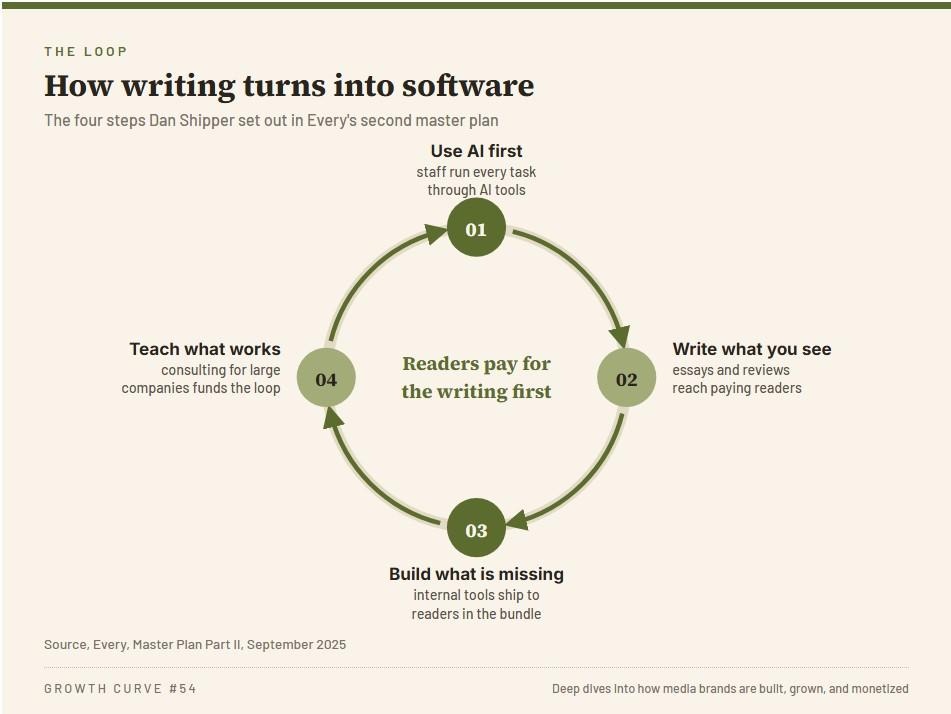
The July 2024 essay also outlined how Every would build software products from ideas explored through its writing and creative work. Monthly recurring revenue had risen almost 8% in the previous 45 days. Spiral, a tool that adapts a piece of writing into different formats, had just passed 3,000 users, and Sparkle, a Mac app that organizes files, was in closed beta.
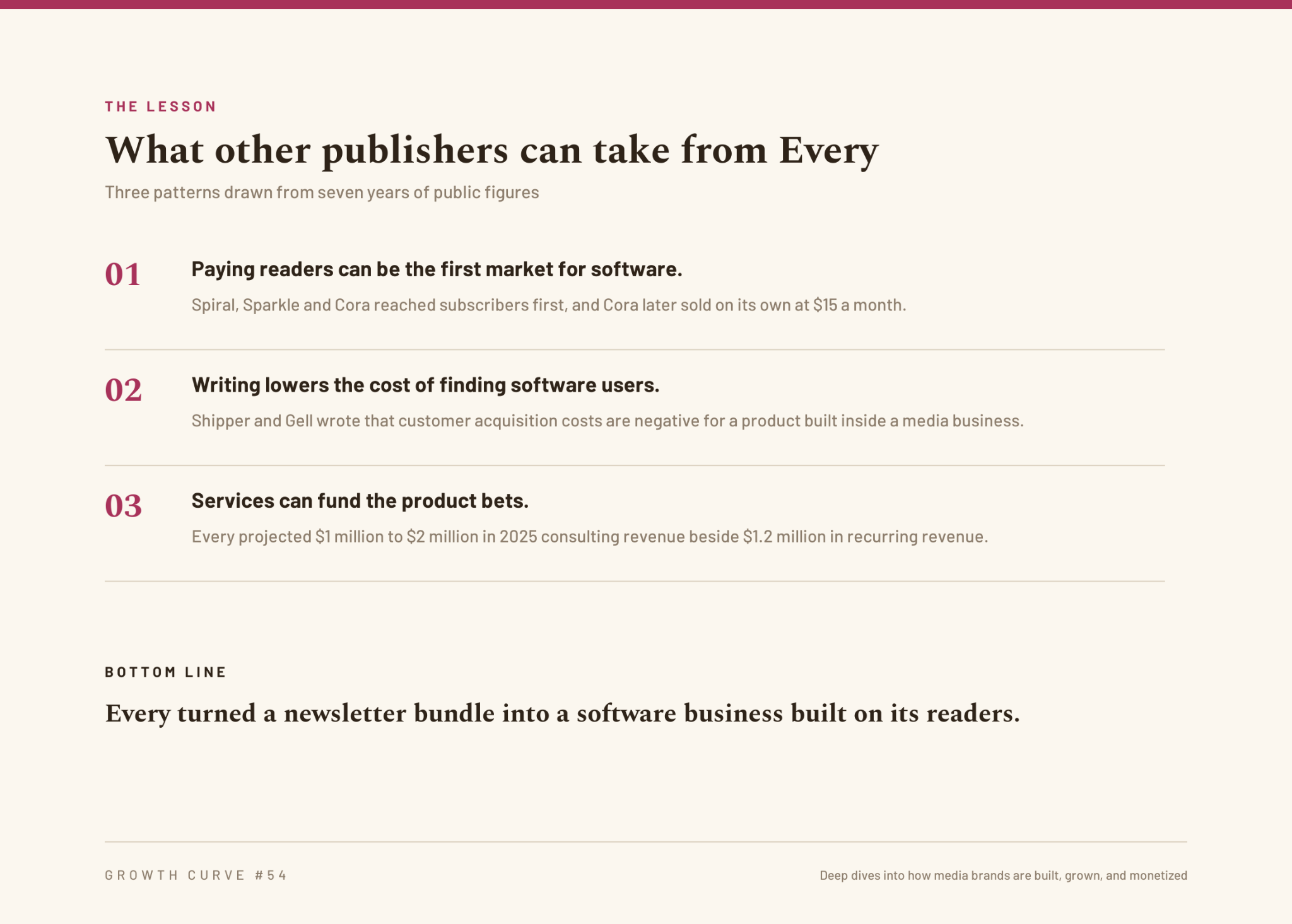
In October 2024, Every launched Every Studio, an incubation arm for AI apps led by Brandon Gell. Before joining Every, Gell had founded the insurance technology company Clyde, led it for seven years, raised more than $50 million, and expanded its team to over 100 people before selling the business. The Studio brought in five entrepreneurs in residence for three-month partnerships, backed by a $150,000 investment from Gumroad founder Sahil Lavingia. Shipper and Gell described customer acquisition costs as negative because subscribers paid for the writing that helped fund the software.
Cora Joins the Bundle
In December 2024, Shipper introduced Cora, an AI email assistant that keeps messages requiring a reply in the inbox and summarizes the rest in twice-daily briefs, delivered each morning and afternoon. Kieran Klaassen built the app as an entrepreneur in residence and became its general manager. By February 2025, Every had reduced Cora’s monthly AI inference costs from $25 to $35 per user to less than $5 by switching newsletter summaries to GPT-mini. Cora joined the subscription bundle with more than 10,000 people on its waitlist.
In May 2025, Every raised $2 million, led by Reid Hoffman. Cora left beta in June with more than 2,500 users and a standalone price of $15 a month. Mercury later reported that Every had reached $1 million in annual recurring revenue by June 2025 and employed 14 full-time and contract staff. In September, Naveen Naidu released Monologue, a Mac dictation app. Its private beta logged about 7,000 uses a day and more than 1 million words a week.
Every Expands Into Enterprise AI Training
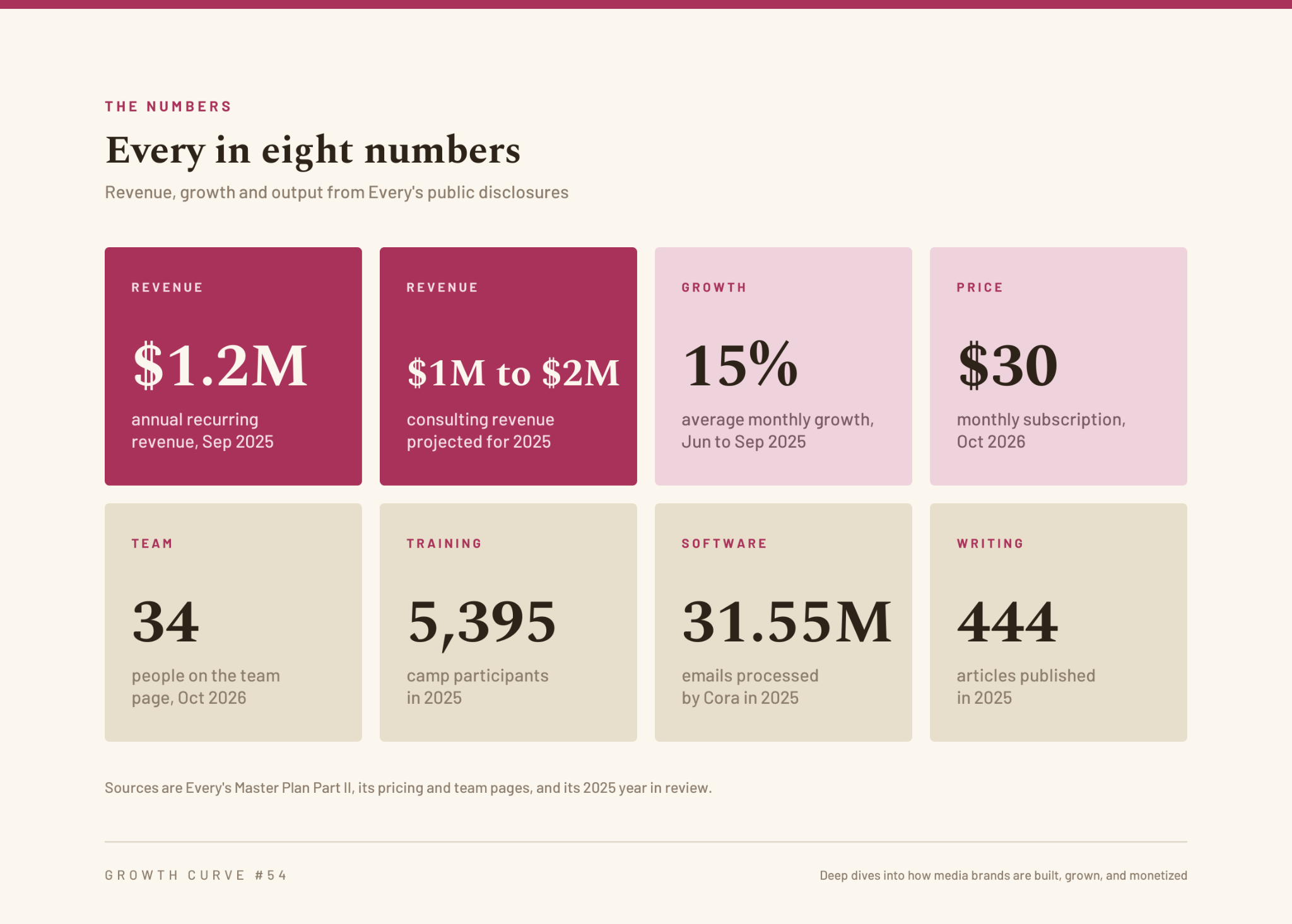
In September 2025, Shipper reported about $1.2 million in annual recurring revenue and 15% average monthly growth over the prior three months. He also projected $1 million to $2 million in consulting revenue for the year from training companies to use AI, with engagements booked through the first quarter of 2026. Shipper wrote that consulting funds the writing and software, opens a route to sell to large companies, and helps the team identify practical uses for AI within those organizations.
Every's 2025 year in review reported 444 articles from 74 writers, 145 training sessions for 1,530 attendees, and 8 camps for 5,395 people. Cora processed 31.55 million emails, and Monologue users dictated 60.7 million words.
Publishing Becomes the Funnel for Software
Casey Newton of Platformer reported on August 20, 2026, that Every had doubled from about 15 people to about 30 in a year, and Shipper told him that AI writes nearly all of the company's code. Every built a copy-editing agent using 30,000 historical edits by editor-in-chief Kate Lee, so staff can request her style on any draft. The team page now lists 34 people, including general managers Kieran Klaassen for Cora, Marcus Moretti for Spiral, and Naveen Naidu for Monologue, and consulting leads Natalia Quintero and Ryan Wright.
Every’s standard subscription costs $30 a month or $288 a year and includes access to Monologue for voice dictation, Compound Engineering to improve coding agents with reusable skills, and Every Agent, an AI assistant available in Slack. Launched in July 2026, the All Access tier costs $625 a year and adds the Builder Pack, office hours with Every’s team, early access to new apps and features, unlimited Spiral usage, and unlimited email accounts connected to Cora. Every also relaunched Sparkle in April 2026.
For publishers fighting shrinking ad revenues and rising reader fatigue, Every offers a roadmap out of the traditional media trap. Instead of relying solely on paid subscriptions or sponsored content to survive, the company used its writing to build trust, spot market needs, and launch software products. The smartest path forward for modern media brands is not just to report on their industry, but to turn industry knowledge and reader trust into a software business.
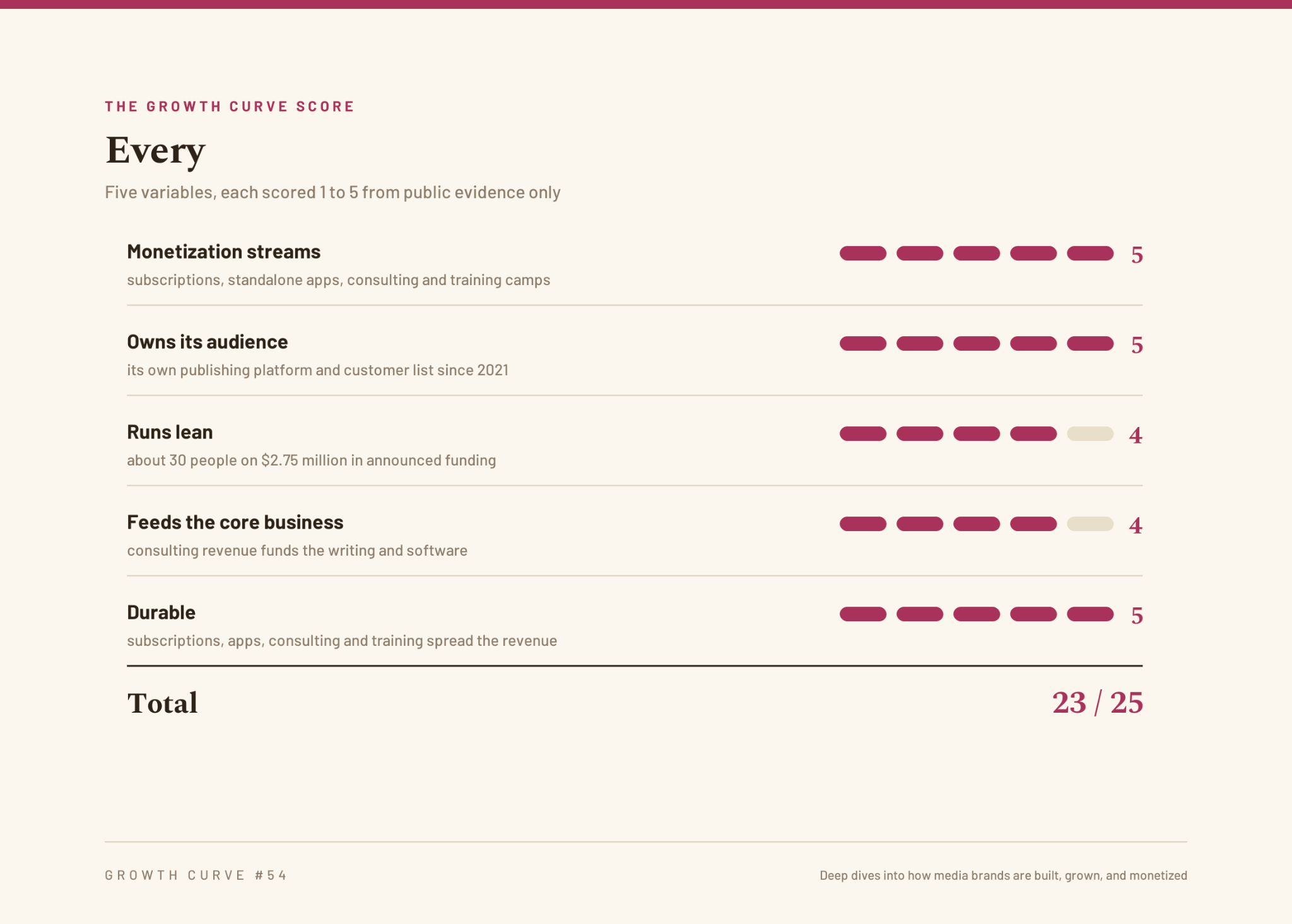
Growth Curve Score
*** Every week, we pick apart how the world's best media brands got to where they are. This post is the long read. Growth Curve, our weekly newsletter, is the sharp version: same insight, shorter format, straight to your inbox. Subscribe free here. ***
Your newsletter won't build itself.